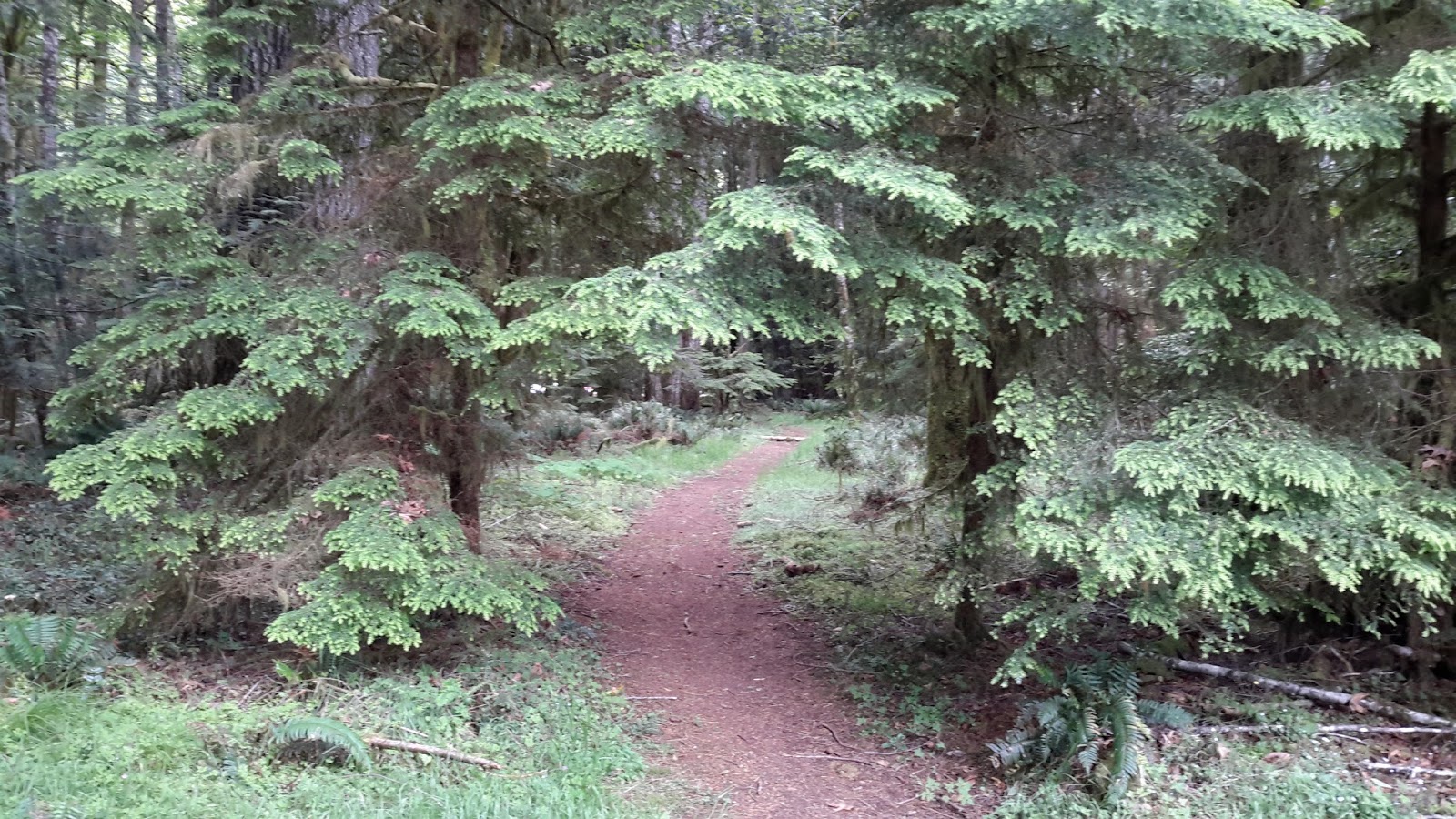
We bush whacked into the woods behind our RV pad near Ashford, Washington. Andrea and I, looking for trail but only finding pathways where deer and other animals have passed previously. That day was cloudy, and a grayness seemed to converge over all things, emphasizing the terrain into a misty glow. We crossed over an old railroad track, long forgotten in which moss covered the medal rails and trees with diameters up to 2 feet had grown between the ties. We stepped carefully, trying not to trample ferns and other flora that was mostly dormant during this winter month of January.
Everything was wet. Recent rains and snows had left things damp and dark. We passed through a meadow, a forest fire of years past and recovering with new pines poking up with new life. Andrea walked on with determination, dreams of finding treasures: a railroad spike, coins from the 1800s or other pioneer antiquities of days long forgotten. I too was looking for treasure, but of a different kind. I was looking for something so profound that even as I write these words, I cannot define them. Something about the depth of life, and the rebirth of spirit.
I was also looking for Bigfoot. Sasquatch. That myth that seemed to be synonymous with the Pacific North West and its deep plush forests. More Bigfoot sightings have been reported in Pierce County Washington, than any other place in the state. Some close to where we were. Although still on the fence as to the true existence of the mythical creature, I couldn't help but wonder if I'd have a chance to experience first hand and prove within myself its true existence. So I kept watch. Looking. Waiting.
We reached a small stream. The waters of snow and glacier melt kept it too swift and deep for easy (or dry) crossing, and Andrea and I resigned to staying put for the time, the sound of the rapid waters enveloping our ears. Our eagerness to cross the stream and see what is beyond the banks, into the woods and the mystery of the unknown was almost too strong to ignore. I kept my vigilance of looking around as if expecting some dark haired yeti to be standing there, looking back at us in the same curiousness, then lumbering off into legend. But the spaces between the thick pine forest remained still. But I couldn't help but get a sense of energy about me as if we weren't alone. It was as if all of my senses were heightened for the first time in a very long time. The Jedi force was working it's magic within me as if even the movement of a snail would be known at that very time and place. Every fiber of my being was reawakened. I felt alive.
But with no treasure to be found, and the waning light fading, we made our way back through the forest, across the old burnt meadow and on to our quiet neighborhood of home. Satisfied we'd experienced something, but unable to define exactly what, we knew that soon we'd be back on our search for treasure, for solitude or for life. Or perhaps to discover a myth out there or within ourselves that had been previously unsolved.
Winter
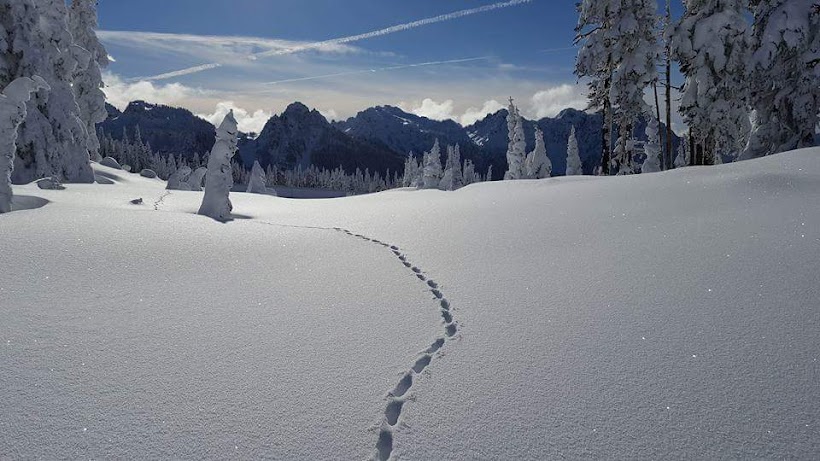
Tracks in the Snow. Photo by John Stoeckl
Thursday, January 26, 2017

Wednesday, December 14, 2016
Deep Snow on the Mountain
My journey began a few days previous when I had arrived at Mt. Rainier for the winter season. Driving in from Ashford and through the park gate, it was like I had entered a new world with the rain and sleet changing to snow, and the clear pavement becoming a sheet of white ivory ice beneath my tires. Driving at slow speeds through coated firs and pines, around slick curves and steep drop-offs, it took me nearly 20 minutes to arrive at the sleepy village of Longmire, the hub of Mt. Rainier National Park.
Snow fell heavily and had already blanketed everything around the historical administrative building, the museum and various other buildings. Pines would on occasion cascade and slough off piles of snow from their limbs to the ground, unable to carry the weight any longer. They looked as if God had poured whipped cream over their boughs so that only shadows of pine green, almost black could be seen beneath the snow. But a strange quiet rested upon the place as if the snow absorbed everything and blanketed the world from all sound.
I had been told it was a normal year for snow, which hadn't been seen in these parts for years. Climate change has receded the "normal" amount of snow leaving many places more rainy, and glacial real estate at a declining minimum. The very next day, we went from Longmire to Paradise, an elevation of over a mile up. The skies were so blue, one had to squint just to look at it, and in contrast with the new fresh white, it was a perfect day to be on the mountain.
 |
| Cascade fox tracks in the virgin snow. |
Donning snow shoes and sunglasses, I ventured out into old trail and virgin snow, through thick stands of subalpine fir and mountain hemlock, so thick with new snow you could hardly see the boughs. Crystal snow reflected the rays of the sun, but seem to reflect even more my own sense of self. A Cascade fox's tracks could be seen tracking from tree to tree, sometimes following my path (or maybe I was following his path), or breaking off in search for sustenance beneath the snow. I felt in awe as the shuffle of my snow shoes through thick snow made me feel small and insignificant in the powerful shadow of the great mountain.
Eventually, I would make my way to a lookout and see the mountain in her majestic stature, waiting... Waiting to erupt in a long overdue volcanic explosion. Waiting to change our world and what we know of it, as Mount St. Helens once did and push lava and ash across western Washington wiping out nearby towns and maybe erasing half of Tacoma. Or maybe, just continuing it's restful sleep unable or unwilling to awake in our lifetime.
I wander back. As J.R.R. Tokien once wrote: "Not all who wander are lost". I continue to listen to the shuffle of my snow shoes in the deep virgin snow. My wandering was always with purpose, albeit not always with direction. For in wandering, we often find ourselves in self discovery rather than journeying to a specific location. But perhaps I am lost. Perhaps it is only the mere reality of my perception of the world around that I am familiar with, but subconsciously, I have no idea where I am. I wander onward as those thoughts of philosophy will have to wait, at least for the moment.
In the meantime, the sun fades into the mountains on our own journey around it, the cascade fox will likely burrow into the well of a tree and find it's sleep. I for one have to leave this place, if not for a night or two. For I will be back many times, on many back country journeys, and perhaps I too will find my way home.
 |
| Snow shoe trail bordered by Cascade fox tracks. |
Monday, December 5, 2016
Anchored into Place (written 2010)

I arrived in Anchorage in late September,
and with the sun only appearing mostly to the south, it felt like I had settled
upon the top of the world. With
exception to the hearty few that clung to the barren branches, the deciduous
trees had already lost most of their leaves, and the season’s shade cover was now
left scattered and dead on the earth floor.
In later years, I would find myself earlier in the season with tripod
and camera, heading up to the nature center in Eagle River and taking colorful
hues of red, yellow and orange, mixed in with the greens of spruce, and other
coniferous trees; scenery that would parallel New England. Fall, being among my favorite seasons, I was
happy to arrive in this new destination I would later call my home. Anchorage had become, like many who’d arrived
before me, a chance for a new life. I
stood intrigued with the dust of snow on the mountains around me, and a
mystique began to grow in wonder as I thought about the wilderness beyond the
metropolis of concrete canyons around me.
I hadn’t come to be a part of Anchorage, but of Alaska, and the lands
that surrounded the largest city in the state.
As I settled into my new home, I began to wonder about living in such a
large city and how it co-existed with the natural environment. Has humankind driven out the wildlife, or has
nature found a way to work within and coexist with man? How far would I have to venture forth to see
the wilderness that I had been longing for; that wilderness that filled my
dreams and romanticized my imagination.
I had to start somewhere to seek and sort it all out. So long as I lived in the city, it would be
my foundation, anchoring me to the opportunity to explore within and beyond the
city limits. For me, the adventure was
only beginning.
Despite the population of over 260,000
people, Anchorage is teaming with wildlife.
Black and brown (grizzley) bear, moose, dall sheep, wolves, coyotes,
lynx, beavers, bald eagles, Canadian geese, as well as other migratory and
resident birds can be seen from time to time within and around the city. The most common sightings of wildlife for me
were moose. It wasn’t uncommon to see a
gangly moose sauntering down Northern Lights boulevard, or standing idly in someone’s
front yard. The first season I lived in
Anchorage, a moose cow wandered into my yard one weekend before the snows
started falling, and took a nap there for a few hours. I didn’t take it personally. I figured this had been her home long before
I got there and in some strange sense I saw a touch of wilderness in my own back
yard. She would come back into my life
at seemingly strange and significant moments of my life as the seasons went
by. In a way, she became a long and
trusted friend that I would remember the rest of my life.
The
Chugach Mountains dominate the city, and I learned quickly it gives the
inhabitants there methods of measurements in several ways. Because the mountain range covers the entire
eastern side of the city, it provides a compass for which to find your way
through town. As a barometer, it also
provides the announcement that winter is on its way. The peaks will begin showing a snow line that
during the fall, will continue to descend down the mountain. When it reaches the valley levels, Anchorage
will see its first taste of snow for the winter. The locals call this “termination dust”,
terminating summer and announcing that winter has indeed arrived.
Deep
within the winter months of November, December and January, the sun peaks out
over the southern horizon, remaining low in the southern sky as if nothing more
than to give the residents of Anchorage a reminder that the light of the sun does
exist during the darkest months. It
rises for only a short 4 hours on the winter solstice, December 21st, coming up
at around 10 a.m. and setting before 2 p.m. The lack of sunlight seems to add to the
winter cold that shrouded the area.
As winter set in, I found myself
habitually watching. Despite the fact I
lived in a regular neighborhood on the east side of town with not much to look
at besides the neighbors across the street, I found myself looking out the
window in constant vigil as if something would happen: a snowfall, a wandering bear, the return of
my moose, or some other adventure I wanted to be a part of. I didn’t want to miss a thing. On top of my evening vigils, I found habit
enjoying coffee on a Saturday morning looking out at the falling snow,
contemplating life, and looking at the change in mystery around me in wonder
for much the same reasons. I also wanted
to find meaning in it all. I wanted this
world to change me, cover me just as the snows did all around my little cave
called home and immerse me in the wilderness of the unknown. But I wasn’t in the wild. I was in the city where humankind has
replaced the natural habitats of the native creatures with skyscrapers, houses,
bike trails, airfields and hundreds of miles of road. These things were the comforts and
survivability of humankind, but in a way I saw them as flaws, those things that
have scarred the land and laid waste to what was. As I watched the snow come, it brought nature
back close to me. It falls where it will
and covers all of the man-made flaws in the world around us. It blankets us in change, and enables us to
hibernate in some way from the contrasts of vivid reality.
Late one evening, I stopped to look
out the front window at the night sky.
It was glowing from the city lights and enhanced by their reflection
upon the snow. It had been a clear
night, cloudless, and stars could be seen through the city haze. There were also two green trails not unlike
aircraft smoke trails that glimmered dully across the sky. I hadn’t seen the Northern Lights before, and
I suspected we had just been introduced.
I wanted to see more. I jumped
into my truck and headed a few miles north of town to Arctic Valley drive, a
road primarily controlled by the U.S. Army.
It was far enough away from the city lights to give me a better view of
the sky. As I got out of the truck and
looked up, the two green trails had mutated into shimmering streams of crystal
white that primarily formed what looked like a huge cone, a floating teepee of
sorts. It was like I was looking up into
the center of the cone and could even see stars within the narrow funnel at the
top. I looked down for a moment long
enough to notice the world around me was glowing brighter. I looked up quickly to see the cone had
changed to what looked like shards of ice and glass showering down upon me as
if it would crush me in certain impact.
The awe-inspiring act lasted only but a moment before retreating back
into long streams of light, ever changing, reflecting upon my very existence.
The winter of 2001/2002 was the
longest in memory, when thinking of actual cold and snow. Although the initial dustings of snow
occurred in September, the first real storm to substantially remain hit the
Anchorage bowl on October 11th.
We didn’t see the bare earth again until May the following spring. It was also the winter that shut the city
down for 2 days. Sunday March 17th. Even after two years in Alaska, I still found
myself on my evening ritual of looking out the front window. I turned off the lights in the house and glanced
out at the street below. Everything
seemed quiet. Deep snow blanketed the
yards of the neighborhood while piles stacked up from the constant need for
plowing. The houses seemed dark, a ghost
town, as if I were the only one there.
 Then I saw movement across the
street in the dark between the houses.
Looking closer, I discovered it was my friend the moose cow. I hadn’t seen her in over a year and wanted
to go out and see if she had some stories to tell. I went out on my deck for a closer look, and
not only received a better visual, but an audio impact as well. The sounds of hooves beating the snow-packed
ground along with her snorting could be heard as she seemed to be aggravated by
something. She was facing a young
sapling that stood in the yard near the street as if the tree were a
threat. She moved to the other side of
the tree by the road, but never gave up her stare of the threatening oak. As if startled by something new, she ran a
full circle around the tree and disappeared back into the darkness between the
houses. She didn’t even say good bye.
Then I saw movement across the
street in the dark between the houses.
Looking closer, I discovered it was my friend the moose cow. I hadn’t seen her in over a year and wanted
to go out and see if she had some stories to tell. I went out on my deck for a closer look, and
not only received a better visual, but an audio impact as well. The sounds of hooves beating the snow-packed
ground along with her snorting could be heard as she seemed to be aggravated by
something. She was facing a young
sapling that stood in the yard near the street as if the tree were a
threat. She moved to the other side of
the tree by the road, but never gave up her stare of the threatening oak. As if startled by something new, she ran a
full circle around the tree and disappeared back into the darkness between the
houses. She didn’t even say good bye.
After a moment of silence, I
returned to the warmth of my living room resuming my evening duties. Moments later, I glanced out the window to
see the initial flakes gleaming within the streetlight. Within minutes, they fell thick and
heavy. It took no time for the plowed
and tired-scarred road to be covered in a thick white-gray blanket. It continued to snow deep into the night. I got up once in the middle of the night to
discover it was still snowing. By the
time I woke in the morning, over 2 feet of snow had fallen. Everything seemed different. The world had indeed changed. Roads were gone. Houses were hobbit holes. Cars were mole hills. The 4 foot chain-link fence in my side yard no
longer existed, completely buried in the glacier that seemed to have fallen
overnight. Schools were closed. Grocery stores and businesses were
closed. The military bases were
completely shut down. The only businesses
that remained open and employed for the next two days were fire, police and
medical services. And snow plows. They wouldn’t reach my meager street for over
a week.
I
sat in wonder at the event of the past 12 hours, the moose, and the
snowfall. My moose must have felt the
oncoming storm and was gearing up for the impact. It all seemed connected somehow to the
natural order of things. Moose come
equipped with waterproof fur shielding the cold along with long gangly legs
giving them the tools to tramp through thick snows with heights taller than
most animals to forage into the higher branches in search for winter
sustenance. Mankind, on the other hand,
has had to use brain and technology to find shelter and transportation, and
warm clothing to survive winters in the arctic while destroying the very
territory that remained with the moose for thousands of years before the
onslaught of human entrapment. She had
warned me of the upcoming snowfall. I
also began to wonder why she had infringed upon my neighborhood. Or was it I that was infringing on her
world? If we continue to spread out,
build more roads, buildings, mine sites, oil rigs and automobiles, what will
become with the last remaining wilderness that is Alaska? Will the moose, lynx, bear, muskox, caribou,
and the arctic ground squirrel become extinct in this part of their world? Was the city pushing out the wild places, or
had they adapted in some profound way to coexisting in the world we live
in?
The thick snow had added to the
mystique that had become my Alaska. It
had become part of the adventure. I
spent these moments in wonder, thinking about the changing world, and how snow
covers up the flaws of man and returns to nature: the natural order of
things. Northern Lights open up a dark winter
replacing the sun with mazes of shimmering light. Reflections of snow off the city also plays a
part in creating light in a dark winter.
As I drove my man made four wheel drive suburban through the unplowed
streets of my neighborhood and stopping to help out a stranded Nissan, my moose
friend gave me yet one more appearance to cap the event of the past 12
hours. As I stood there next to the open
door of the Nissan, she bolted back out between the same two houses and ran two
circles around our vehicles in the street.
She was almost close enough to reach out and touch in her race around
us. She then disappeared up the
road. It was the last time I saw the
snow fall like that in the city. It was
also the last time I would ever see that moose.
When I think back on those cold dark
winter months, I often wondered why I was so attracted to living in such a
place when many want to retreat to the golf courses of Arizona and
California. Perhaps it’s the transition from
seasons that creates a parallel to life as we follow the transition of the sun
and the tilt of the planet. Perhaps
winter was that time to slow down, see the world from a different perspective,
gaining perspective and appreciating the warmth of new life in springtime. Perhaps it’s just a change from knowing life
in the days of summer when fishing, hiking and camping are a constant, and the
season gave me time to slow down, relax and reflect. As I write these words, I’m more in awe that
the winter world I experienced up there brought nature to my very doorstep, lit
my skies with the Aurora Borealis, and gave a comfortable place for a moose to
nap. Whether it be change or adventure,
I will always remember that time as special, and it will always keep me grounded
within myself, and anchored into this
place.
Thursday, December 1, 2016
Through the Veil
I was in search of other things. A moment of quiet. A moment alone. A sense of solitude. I could hear my breathing pounding ever harder within my chest as I traversed up the trail in quickened pace. I often did that when looking for a piece of solitude on a visitor busy access trail. As expected, families from all over were on this popular trail to Meremere Falls, and their voices carried through the trees all around me as if I was really in the outer reaches of Rivendell and would be greeted by the elves at any moment.
But I was in search of other things. A moment of quiet. A moment alone. A sense of solitude. I did that often after being pummeled with information technology, telephones and computers and a life filled with the troubles of the world. My goal was not to walk in harmony with the happy faces around me, but to get away from it all, as we rangers often need to.
I turned off the main path to the water fall, and traversed a less popular Barnes Creek trail. There was no close destination at the end of this trail, for this path took people for rarely no other reason than to spend a few days in the howling wilderness, with tent, bear cans and a sense of adventure. For me, I was one of the rare who came here just for a moment out of my busy day.
From the moment I entered this new realm, my world changed. Out of cell range, no chance of that contraption pleading for me to answer a notification. The voices of the previous trail faded away. Before me was a plush forest trail running along side the creek. During a previous storm, two clumps of trees fell over the path. So large were these trees, I had to clamor over and under and through the tangle. Once I was past all of that, a quiet descended upon me. Only the sound of the creek could be heard. I had literally entered a veil into another world.
I walked on for some time, stepping around muddy puddles and marveling at the thick canopy of Douglas, Western Hemlock and Western Red Cedar. The creek, still swollen from the rains, pushed it's way aggressively down hill in search for the ocean. I kept going, wanting to see the mountain, the lake or any other possible secret this trail had to show me. The sounds of a woodpecker could be hear tapping off in the woods a ways. Fallen logs nursing new growth and blanketed in moss surrounded me. I stopped walking and let my breathing come to a quiet. The creek, the woodpecker, and a gentleness of breeze were all that I could hear. For every forest has a feel to it--a uniqueness unlike any other. Usually it's missed. But I've found if I stop and listen, smell and taste all that my senses can endure, I can put a name to that forest.
With senses renewed, I headed back down. Breaking through the veil and into the world of people once again, but ready to take on the world anew. Somewhere down the trail stood my ranger station, my computer, the contacts of my cellphone and ultimately my walk home. For my purpose fulfilled: I had found my moment of quiet, my moment alone and a sense of solitude. But there will be other places. Mountains much higher. Trails much deeper. Other veils for which to find my own piece of wilderness.
But I was in search of other things. A moment of quiet. A moment alone. A sense of solitude. I did that often after being pummeled with information technology, telephones and computers and a life filled with the troubles of the world. My goal was not to walk in harmony with the happy faces around me, but to get away from it all, as we rangers often need to.
I turned off the main path to the water fall, and traversed a less popular Barnes Creek trail. There was no close destination at the end of this trail, for this path took people for rarely no other reason than to spend a few days in the howling wilderness, with tent, bear cans and a sense of adventure. For me, I was one of the rare who came here just for a moment out of my busy day.
From the moment I entered this new realm, my world changed. Out of cell range, no chance of that contraption pleading for me to answer a notification. The voices of the previous trail faded away. Before me was a plush forest trail running along side the creek. During a previous storm, two clumps of trees fell over the path. So large were these trees, I had to clamor over and under and through the tangle. Once I was past all of that, a quiet descended upon me. Only the sound of the creek could be heard. I had literally entered a veil into another world.
I walked on for some time, stepping around muddy puddles and marveling at the thick canopy of Douglas, Western Hemlock and Western Red Cedar. The creek, still swollen from the rains, pushed it's way aggressively down hill in search for the ocean. I kept going, wanting to see the mountain, the lake or any other possible secret this trail had to show me. The sounds of a woodpecker could be hear tapping off in the woods a ways. Fallen logs nursing new growth and blanketed in moss surrounded me. I stopped walking and let my breathing come to a quiet. The creek, the woodpecker, and a gentleness of breeze were all that I could hear. For every forest has a feel to it--a uniqueness unlike any other. Usually it's missed. But I've found if I stop and listen, smell and taste all that my senses can endure, I can put a name to that forest.
With senses renewed, I headed back down. Breaking through the veil and into the world of people once again, but ready to take on the world anew. Somewhere down the trail stood my ranger station, my computer, the contacts of my cellphone and ultimately my walk home. For my purpose fulfilled: I had found my moment of quiet, my moment alone and a sense of solitude. But there will be other places. Mountains much higher. Trails much deeper. Other veils for which to find my own piece of wilderness.
Friday, November 25, 2016
South of Solitude
The cloud cover seemed low in the arctic. It gave me the impression of being on top of the world, so high that even the sky reached the earth. I stood on a hill surrounded by dwarfed pines and lichen in Denali National Park. The mountain itself was shrouded in clouds. I would not see it that day. What I would see is a rolling wilderness that went on for 100 miles in any direction--that feeling of solitude so profound you can eat it for breakfast. Down in the valley before me, a bull moose stood torso deep in a lake dipping his head under the water in search for sustenance.
My mind was, as it is for many who venture out of their vehicles in the Alaskan wilderness, was the Alaskan grizzly. Majestic. Powerful. Even romanticized. You couldn't help walking in this country without thinking about the bear. For here is their home. They live everyday in the solitude I write about. Here in Denali, their livelihood is relatively unchallenged.
But elsewhere in Alaska, and almost the entire lower 48, they are challenged to the point of being endangered. Considering that at one time, this majestic beast once roamed nearly all of America, and even dwelt in Mexico. Today, they live in pockets of Washington, Idaho, Montana and Wyoming. South of solitude. Their only true stronghold is in Canada and Alaska.
And I have hiked in both Alaska and south of solitude. There's something different about walking in the wilds of Alaska and then returning to, say, the Cascades, the Sierra Nevadas, or even much of the Rockies. For many, south of solitude is wild, deep and impenetrable. For me, every time I walk in what once was grizzly country, but hasn't had a grizzly for over 100 years, something is missing. It almost feels like there is no solitude there. It feels like I can turn around at any moment and see another person, a town, or a highway just past the trailhead. It's a terrible feeling to undergo for someone who'd spent a lot of time in the mountains prior to moving to Alaska.
Where there is wilderness left in Alaska, it's dwindling, just as it is everywhere in our human controlled world. At one time, humans lived in harmony with all the animals. Today, it's about development, revenue, and recreation. But the more we develop, the more money we make from that development, the less solitude any of us will feel in the back country. One day we may return to the wild places to find the grizzly completely gone. There's a sadness to that thought. For there too, even in Alaska, will be south of solitude.
My mind was, as it is for many who venture out of their vehicles in the Alaskan wilderness, was the Alaskan grizzly. Majestic. Powerful. Even romanticized. You couldn't help walking in this country without thinking about the bear. For here is their home. They live everyday in the solitude I write about. Here in Denali, their livelihood is relatively unchallenged.
But elsewhere in Alaska, and almost the entire lower 48, they are challenged to the point of being endangered. Considering that at one time, this majestic beast once roamed nearly all of America, and even dwelt in Mexico. Today, they live in pockets of Washington, Idaho, Montana and Wyoming. South of solitude. Their only true stronghold is in Canada and Alaska.
And I have hiked in both Alaska and south of solitude. There's something different about walking in the wilds of Alaska and then returning to, say, the Cascades, the Sierra Nevadas, or even much of the Rockies. For many, south of solitude is wild, deep and impenetrable. For me, every time I walk in what once was grizzly country, but hasn't had a grizzly for over 100 years, something is missing. It almost feels like there is no solitude there. It feels like I can turn around at any moment and see another person, a town, or a highway just past the trailhead. It's a terrible feeling to undergo for someone who'd spent a lot of time in the mountains prior to moving to Alaska.
Where there is wilderness left in Alaska, it's dwindling, just as it is everywhere in our human controlled world. At one time, humans lived in harmony with all the animals. Today, it's about development, revenue, and recreation. But the more we develop, the more money we make from that development, the less solitude any of us will feel in the back country. One day we may return to the wild places to find the grizzly completely gone. There's a sadness to that thought. For there too, even in Alaska, will be south of solitude.
Tuesday, November 15, 2016
Rain on the Peninsula
It's been raining quite constantly since my return to the Washington peninsula of Olympic. Almost at a constant rhythm, it only quiets for a few minutes, a few hours, or maybe a day. Then the pelting continues.
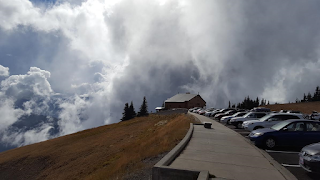 I spent my summer on the Olympic peninsula as a ranger and guide. I look at these experiences as something more to add to my files--those things I can refer back to on occasion. I lived by a lake. A cold clear lake carved by a glacier. I then drove to town, caught the route south and up to the ridge where I led guided hikes or talks. I learned to talk about Douglas and subalpine fir, western and mountain hemlock and of western red cedar. I learned to add intangibles, universals and emotional human connections to that which is nature. I connected salmon with glaciers and climate change.
There was a lot of sun up there during the summer. And the crowds were enormous for a place that is supposed to be a refuge from life. Crowds, like the rain, seemed to pelt in constant rhythm that only subsided for a moment, an hour or a day. But some days were quiet. Usually I'd search for those quiet places for which I could retreat, take in a sight and be alone for, if nothing else a moment. One time I stood at the edge of an overlook among tall subalpine firs. I was at an elevation of around a mile up, but only a mile away from the visitor center for which I spent most of my time. I felt reflective that day--searching for a spiritual sense of self. The crowds had overwhelmed me. As an introvert, I needed quiet. Then something caught my eye. A shadow above me. I looked up to see the blood red wings of a red tail hawk. It swooped over me as if to wonder what I was and why I was there. Or it was to send me a message that this is a place untrammeled and I am suspect to being welcomed in his part.
But now the summer season has moved on to fall. A quiet descends upon my lake. I no longer climb to the ridge for work and haven't seen it for over a month. The sounds of the crowds have been replaced by rain. Tears of joy. Tears of life. Tears of pain. They are constant. And long after I've gone, they will continue coming down for a few minutes, a few hours, or a few days.

 I spent my summer on the Olympic peninsula as a ranger and guide. I look at these experiences as something more to add to my files--those things I can refer back to on occasion. I lived by a lake. A cold clear lake carved by a glacier. I then drove to town, caught the route south and up to the ridge where I led guided hikes or talks. I learned to talk about Douglas and subalpine fir, western and mountain hemlock and of western red cedar. I learned to add intangibles, universals and emotional human connections to that which is nature. I connected salmon with glaciers and climate change.
 There was a lot of sun up there during the summer. And the crowds were enormous for a place that is supposed to be a refuge from life. Crowds, like the rain, seemed to pelt in constant rhythm that only subsided for a moment, an hour or a day. But some days were quiet. Usually I'd search for those quiet places for which I could retreat, take in a sight and be alone for, if nothing else a moment. One time I stood at the edge of an overlook among tall subalpine firs. I was at an elevation of around a mile up, but only a mile away from the visitor center for which I spent most of my time. I felt reflective that day--searching for a spiritual sense of self. The crowds had overwhelmed me. As an introvert, I needed quiet. Then something caught my eye. A shadow above me. I looked up to see the blood red wings of a red tail hawk. It swooped over me as if to wonder what I was and why I was there. Or it was to send me a message that this is a place untrammeled and I am suspect to being welcomed in his part.
But now the summer season has moved on to fall. A quiet descends upon my lake. I no longer climb to the ridge for work and haven't seen it for over a month. The sounds of the crowds have been replaced by rain. Tears of joy. Tears of life. Tears of pain. They are constant. And long after I've gone, they will continue coming down for a few minutes, a few hours, or a few days.
Tuesday, December 29, 2015
Falling Ice - A Season in Prince William Sound Alaska
Of Falling Ice

"No, it's just seasonal." I was responding to a common question in regards to my being a Forest Ranger aboard glacier tour boats for the summer. I can see the quizzical look in her eyes and can already anticipate the next question. "So, what do you do in the winter time?" she asks with sincere curiosity. I'm sure she can see the smile start to curl at the ends of my mouth as I get ready for the punch line. "I starve." I respond with a certain level of animation in my voice. Her eyebrows raise. She's an elderly woman from Kentucky. Before she could answer I add "...But if you give me your address, I may need to crash at your place." She smiles. She got the joke. After I explain that the Forest Service, or the Park Service as far as I know, doesn't give us a year round cycle of employment--that each job needs to be applied for. Although I'm sure many seasonal rangers have secured winter gigs due to long acquired trust of their supervisors, for me it was my first season, and still a relatively unknown ranger. In other words, feast or famine. The woman offers me a room any time I want, as well as a free pass to Mammoth Caves National Park near her home. I smile and give her my gratitude for the offer with the promise it may be considered.
I spent a season in Alaska, in addition to living in Anchorage, Ketchikan and Juneau. I've been as far north as Barrow and seen the Arctic Ocean. I've been as far south as the southern end of Revillagagedo Island where Ketchikan lies. I've seen Tok, Homer, Seward, Kenai, Fairbanks, Soldotna, Sterling, Hope, and Trapper Creek, just to name a few. But my season out of Whittier and the exploration of much of Prince William Sound as a seasonal Forest Ranger will likely be my most memorable. On these boats I may be guiding 50 to over 340 visitors on any given day, cruising a typical round trip of 140 nautical miles into Prince William Sound and seeing such historical places as College Fjord, Harriman Fjord and journeying through history as well as the notable signs of a land that shows effects of climate change like no other. But nobody wants to talk about it. So, I smile and press on.


The terrain is fascinating. It's more like magical. Every day I preach that this is a journey that we are on. A historical journey. A natural journey. But really it's a personal journey. I invite them early on in the cruise to open themselves up to that journey and enable the possibility of change. For most, that change happens. Only a remote few are too concentrated on playing cards and visiting the bar on board to notice that I'm even talking, or that there's a world they're missing.
The weather is rainy today, so my narrative is limited to the low cloud ceiling and the windows are fogging up on the boat. We head out of Whittier, and I pull out my introduction as a Forest Ranger and this journey we are embarking upon. The waters are choppy today. The mountains are shrouded in cloud. We pass Poe Glacier to the left of us. They can barely see the foot of the glacier as I explain it was named after Edgar Allen Poe by the U.S. Geodetic Survey in the early 1900s. About 10 minutes later, we pass Tebenkof Glacier. It was named for the last Russian governor of then Russian controlled Alaska Mikhail Tebenkof. It's the largest valley glacier in Prince William Sound at 8 miles long and about a mile wide, but I don't mention it. They can't see it. For now, the clouds will bury the glacier in unknown mystery.
A few days later, the rains have cleared and the visitors are rewarded with an amazingly sunny day with views beyond amazing. They're profound where words cannot describe. I emerge from my Forest Service bunkhouse, coffee in hand, and go for a walk in Portage Valley before my day's work. I notice everything in this quiet valley. Peaceful. Alluring. The fireweed is now in full bloom with a vibrant purple hue contrasting against the deep and gray greens of spruce, hemlock and cottonwood--images of plant succession in this valley. Moose and black bear frequent around me and I consider my own ineptitude in such a holy place.
Later I board the boat with a new introduction. "Wow! What a beautiful and sunny day!" I begin. "This morning I donned my Forest Service Uniform, tied my Forest Service hiking boots, poured my Forest Service coffee in my stylish Forest Service mug--stirring it with a twig (for added humor)." I look around. My audience is intrigued. Their minds are entertained with "where is he going with this?" I continue. "And I do what any respectable ranger would do on a day like this. I go for a walk." They could see me pacing back and forth along the front of the boat like a standup comedian. "The birds are chirping. The sky is vibrant blue against the snowcapped mountains." You could hear a pin drop between sentences. All eyes are on me and I know my stage is set. This was my day. "And on days like this, my mind begins to wonder. Those types of thoughts that keep one up late at night..." My audience is still intrigued and I cannot wait to lead them to the punch line. "Today's thought: Where do rangers go to get away from it all?" Laughter ensures. Some of it is polite. But most of it is in appreciating the profound thought that makes up rangers in Alaska. Where do rangers go to get away from it all in a place a beautiful as this?
Tebenkof is in full view now. All 8 miles of it. You can even see traces of the Blackstone-Spencer Ice Field that feeds it if you look close enough. It's going to be a good day. Later we head into College Fjord where we stop about halfway seeing the massive Harvard Glacier, the 2nd largest tidewater glacier in Prince William Sound in the distance. It's an amazing 24 miles long, and only pales in comparison to the Columbia glacier, which is too far for this tour boat to get to. Remnants of fallen ice float along the shores around us. Stripes of medial morraine contrast the glacier in black and white. The tour boat captain announces we aren't going to get any closer to Harvard today. They normally don't. Other glaciers are more "user friendly" he says. In other words, they calve ice more often. Still 11 miles out and all the ice in the water, I'm not convinced. But I'm not the captain. This glacier will have to wait.
We make our way to the Harriman Fjord and I intrigue the visitors with what it was like in 1899 when the opening of the fjord before us once greeted E.H. Harriman and John Muir with a 400 foot wall of ice, and how it blocked this hidden cove from Russian fur traders. Only during the Harriman expedition did John Muir, known as the resident glaciologist from Yosemite National Park, recognized the terrain behind the wall of ice as a likely bay of water carved by glaciers and then filled with sea water. A fjord. My tourists are on their feet, crowding me, all attention on the forward windows of the boat as I describe this place in history in 1899. I have again captured their full attention. As we round what is now known as Doran Point, they can see it. The bay opens up. In the distance: Surprise Glacier. It's halfway up Harriman Fjord. Other glaciers also dominate the scenery. Cascade Glacier. Serpentine. Hanging glaciers grasp upon the upper peaks like glue. But Surprise is a calving glacier, almost expected to give them a show. The captain ventures toward it and everyone is captivated.
But Surprise Glacier is quiet today. She sits there with her blue and white glacier wall. There are harbor seals sunning themselves on recently calving ice bergs that engulf the bay around Surprise so thick that you could hear the catamaran rails scrape and bump against the brash ice as it makes it way to Surprise. Through a monocular, I count the seals. I stop short of 300. The harbor seals stress a little at the approach of the boat. They see us most days, but we don't see them normally in these numbers. The closest ones leave their haven of ice and seek refuge back in the murky silt of glacier fed waters. We spend time around the face of the glacier. The tourists are hopeful, but everything is quiet.
I wander around the deck shagging questions. One common question is, "Is this global warming thing real?" I explain that over 95% of climatologists agree that it is. In Alaska, these glaciers are receding in just a few short years in what used to take them a hundred. Permafrost is melting for the first time. Alpine levels are rising. The spruce bark beetle on the Kenai Peninsula is surviving two years instead of one. All signs of a warming planet that has significantly changed since the onslaught of the industrial revolution. Even the American President Barrack Obama would later come to Alaska to explore evidence of these changes. Suddenly a rumble happens. It breaks the din of conversation like a thunder in the night. Looking toward the face of Surprise glacier, she releases yet another scattering of ice into the water in her own summer retreat. She would regain some of here length during the winter months when snows and cold would allow her to advance. But it's not enough. The writing is on the wall. Like Glacier National Park, she too may be one of many glaciers to become extinct. I realized that I was witnessing a part of history. For next summer, all may be different.
My last day of the summer approaches. I suggest to the captain of the boat that we change our route and go see Harvard Glacier up close, in all of its spender. The captain stares off into the distance for a moment in consideration. Perhaps... For now, it's just another day. The fishing boats are in full course. Very little sign of changing seasons is notable on this last day of August. All is peaceful. All is silent. But my audience is intrigued with my ranger stories, and somewhere a violent head wind is pushing hard in Harriman Fjord. Shortly after leaving Esther Passage, the public address comes across with the familiar tone of the captain announcing that we were changing our route due to the winds, and heading off to Harvard Glacier. The eruption of cheers began with my own and I quickly grab my microphone to announce what a rare treat this was. The visitors are truly blest. Little did I know what lay before us.
As we approached Harvard Glacier, it's massive faced engulfed the scenery before us. The boat turned this way and that to give each of the those still seated a chance for a full view. I, along with many of the passengers went out on deck. I held my phone, video camera and all, and waited. No one wanted to ask me questions. All eyes were on the 1000 foot wall of ice waiting in guarded expectation. And then it happened. A solid wall of ice directly in front of us calved in what was the most massive calving of the season. The roar of the ice falling equaled that of total Armageddon. The falling ice fell, cascading into the ocean in a series of release. First the initial release, about the size of the empire state building, followed by both sides of it giving way. It was followed by a sudden wave that rose from the water and eventually rocked our distant location. I then realized that this journey wasn't meant to touch the souls of the visitors, but mine as well.
As we approached the sleepy village of Whittier and the end of our journey, I couldn't help but think about the special experiences I'd encountered. I grabbed my microphone and began summarizing the journey we'd been on. Glaciers. History. Humpbacks. Dall's porpoise, harbor seals and sea otters. 5000 blacklegged kittiwakes engulf the rookery outside of Whittier. Somewhere distant bald eagles, black bears, brown bears, and sea lions spend their days hiding from the constant onslaught of modern visitors. I think about my opening, about where rangers go to get away from it all. I open up with a speech that includes this incredible journey we'll all experienced. As for where rangers go? I paraphrase notable nature author Edward Abbey who, in the first chapter of his book Desert Solitaire, says that where we get away from it all is what lies special within each and every one of us. It could be Yosemite National Park, the high country of Colorado, or the very special experiences of Prince William Sound Alaska. For we will never see this place, or our lives in quite the same way again. Everyone is touched. I receive an applause by visitors I'll never likely see again. And I too am touched, nor will I ever forget them.
Subscribe to:
Posts (Atom)