Winter

Winter
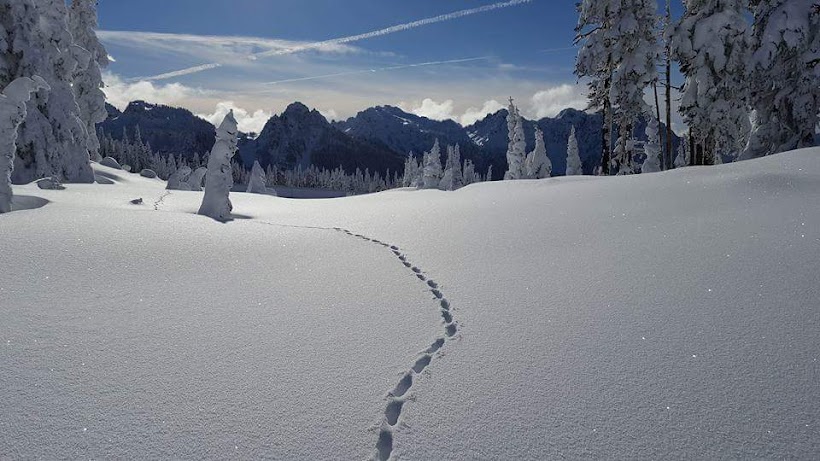
Tracks in the Snow. Photo by John Stoeckl

Tuesday, September 4, 2018

Grave Creek

I'm shifting gears.  A little bit of history.

Those that know me know that I love to delve into historical places, especially when it comes to the old West:  Ghost towns.  Vintage locomotives.  The history is darkly vibrant.  Or vibrantly dark.  I seek to hear the whispers of the past.  What stories would they tell?

I drove up to Sunny Valley and stopped at the Applegate Museum which I was quite impressed with, with interpretive displays of the Applegate Trail and its history.  Just down the road from the museum is the covered white bridge, which crosses Grave Creek. 


According to HMdb.org, or the Historical Marker Database, the year was 1846.  The Crowley Family on their last leg of the Applegate Trail (southern alternate route to the Oregon Trail) heading north stopped at the creek to bury their daughter, who around the age of 15, died of Typhoid fever.  They buried her just beyond the bridge.  Due to the event, the creek was named Grave Creek.

I stood at the edge of the creek, looked through the covered bridge and wandered over to Martha's grave site.   My mind tends to wander in moments like this.  What if you could take away the bridge, the roads, the houses and put yourself back to 1846?  What if we took away our modern conveniences of heated (or air conditioned) vehicles that can travel 70 miles an hour on the interstate getting us 120 miles in just 2 hours?  What if we had to be on foot, or on horseback, pulling a wagon at a whopping speed of 3 mph, taking us months to cross the Western territories through the heat of summer and the cold of winter?  What fears would we experience?  Native Americans fighting for their homeland?  Predators such as wolves, bears, or cougars?  Or what about a worse fear, such as starvation, hyperthermia or just plain being lost in the wilderness? 

Standing there at the face of the grave of Martha Crowley, I could hardly imagine with a family's hopes and dreams of completing the journey to the promised land of Oregon, setting up a farm, finding prosperity and watching your daughter grow into a woman, get married and bring grand children into their lives.  But that's not the history.  So much of it is skewed.  So much forgotten.  All that is left is the grave site, and the name of the creek, and a covered bridge that marks a moment, a long forgotten moment of history to those who pass by on Interstate 5 with only the distant view of a white wooden covered bridge in the distance--hardly noticeable unless you look.

Looking out over the hills imagining their time in 1846, and looking down at the deep green mossy creek and how the wagon train must have crossed it, there were no whispers.  There were no stories.  Just a gentle breeze of a long forgotten moment on a late summer day in southern Oregon. 

Thursday, August 9, 2018

Smoke at the Bolan Mountain Fire Lookout

Bolan Lake as seen from below the fire lookout.
I stood at the edge of Bolan Lake, it's clear waters rippling in the gentle breeze.  Serene lakes always seem to deepen the mind and reflect upon the soul.  Across the water the deep green trees covered ridges surrounded the lake like mountain cathedrals.  In my own life's pain and confusion, I look to the forests for solitude and solace.  Paths intertwine with one another and life normally finds clear views ahead.

But the valley was somewhat obscured here as it is in my own life.  Smoke from the Nachez fire just south across the border in California shrouded the valley all around us as a fellow ranger and I began our trek up to the Bolan Mountain Fire Lookout above the lake.  It was mid morning, 70 degrees, and our hike would take us 1.7 miles  to an elevation of 6242 feet.


Indian's Paintbrush
Our feet crunched beneath the deep rich soil, rocks and pine needles that had scattered.  Douglas firs filled the forests  around us as well as various shrubs and ferns that carpeted the forest floor.  As we gained elevation, the Douglas firs were replaced by subalpine firs and mountain hemlock.  Wildflowers scattered upon the occasional meadows we'd come across.  Blues, purples, oranges.  Fireweed.   Indian's Paintbrush,  and others I'm not familiar with being new to the region.  The forest was alive with color and contrast.


The trail to Bolan Mountain Fire Lookout
The trail pushed us further up.  We crossed over a section of basalt piled up from a landslide long forgotten-its gray jagged forms covering all things living.  My partner mused the rock pile could easily be a covering for a cave for a mountain lion or a bear.   I stood looking down through the narrow openings between the rocks and wondered if that could be true.  I thought about climbing down to the face of the mountain below us to find out, but decided against it.  We had to get to the fire lookout. 


The trail continued upward with switchbacks changing our direction often until we went over the saddle and down into the adjacent valley.  More paths intertwining with each other.  The trail hit a junction where we had the option of continuing on to Kings Saddle just south of Grizzly Peak, or turn right and head down a small valley and back up toward the lookout. 

Pondering the mindset of people over time and the naming of Grizzly Peak.  Oregon hadn't seen grizzlies since the early 1900s--the result of heavy predator hunting by pioneers of the time.  Still the name gives one pause as to its origins.  I wondered what these mountains may have been like back in the 1800s, when hiking similar trails was more out of necessity rather than recreation, and the fear of America's monarch of the wild, the grizzly bear, was among the greater fears of being present in these rugged mountains.  It was the mindset back in the day to kill all bears and make the mountains safer.  Many still feel that way.  But the whole concept that a keystone species like the wolf and the bear are actually better for the environment making forest ecosystems stronger wasn't considered until recently.  Discussions of returning grizzlies to the Cascades in Washington and other places are now at least  being talked about. 

Change happens. 

I have to wonder if some day I will walk these mountains with a feeling of danger and wariness with the idea grizzlies could be here.  The thought excites me.  We look for change in the drywalled and concrete canyons of the halls of government, but it's here in the mountains that the real changes are inflected.

At trails end, we found the road to the lookout and made our way to the top.  Bolan Mountain Lookout stood on the top of the ridge, as most lookouts do, for the purpose of detecting fires.  Replaced by modern technology of air craft and other resources, many fire lookouts have been decommissioned.  They either stand empty, boarded up and forgotten, or they become cabin rentals.  Bolan falls into the latter of these with its latest occupant having picked up the key the day before on her two day adventure. 


Bare necessities inside the Lookout.
But the parking spot was void of any vehicle and the lookout locked up and quiet.  The occupant had departed early.  I climbed onto the deck that wrapped around the entire lookout and peered in the windows.  The scientific and radio equipment was removed and replaced with the bare necessities for a cabin rental:  table, chairs, bed, cabinet and amazing views.  An outhouse sits about 20 feet below. 

All the modern conveniences of life. 

While standing on the decking and looking both inside the lookout as well as at the smoky views around me, it gave me a moment to wonder what the summers were like for fire lookout rangers.  Most stayed in these primitive settings for months at a time with little contact with the outside world besides the occasional radio checks and shopping trips for food.  Solitude is what I think of.  No internet.  No cellphones.  Just the quiet of being on top of a mountain.  Viewing a lazily soaring red tail hawk.  Looking for fires.  Experiencing the violent rush of lightning storms crashing all around and then looking more aggressively for fires afterward. 

Then returning to the quiet.  

Author standing on the decking amid smoke filled skies.
For some, fire lookout duty undoubtably  would be an extremely loud silence.  Exhaustive to spend so much time alone.  For me I think I would have embraced it with long hours of writing, exploring and deep contemplation about life and spiritual connections.  I'd get lost in my own muses and likely come back down off the mountain a different person when the fall turns to winter and the snows cover the mountain blanketing it in cold hard change and driving me to other adventures.

To be someone who is willing to take a long moment to pause in the vast geologic expanse of time and open yourself up to become something more profound--so profound that words cannot express it.  Nothing can.  To see the world differently.  To see the mountains for what they are.  To see the bears for what they are.  To allow yourself to breathe in the world around you in its stillness and listen to the voice within.

Change.

For today, the world is obscured.  The paths here are intertwined and it's hard to see my way ahead.  It's obscured not only by the smoke that surrounds the peaks around this fire lookout, but also by the limited time spent here.  For being here for just a moment in a day is much less significant than an entire season, and a season much less than a lifetime.  But we all play our part.  Each of our life's experience changes us in minute ways, sometimes as quiet and unseen as the carving of sandstone over decades, or as explosive as the strike of lightning across dry forests in southern Oregon engulfing it in smoke and fire.  Eventually the smoke clears and a new way forward is seen.  The burn scars remain but regrowth happens.  Time heals all wounds.

My moment has ended.  It's time to head back down the mountain.  Some day I'll be back here, or perhaps to another fire lookout for I'm hooked.  Maybe I'll stay for a night or two.  Maybe I'll stay for a season. 

It might even change me for a lifetime. 

Saturday, August 4, 2018

The Wandering Ranger

I'm looking for new inspiration to write, to share and to illustrate the deeper thoughts and feelings within me.

On a quiet Sunday evening while working on my book, I find myself taking the time away from writing to think about all the adventures I have been graced to witness in my life.  Not that I'm gloating but rather that I feel blessed.  I've been to Canada and Mexico, driven the Alaska Highway 6 times, lived in Germany and Holland and have traveled as far as the middle eastern country of Kuwait.  Each place has had it's unique qualities and differences from one another.  Primarily, those times when I found myself in desert, I longed for the mountains.  Or when I was in the mountains, I longed for the ocean.

My hero is Edward Abbey.  I first read his book when I was a teenager in high school.  My 10th grade biology teacher had given my brother and I the book as an end of year gift.  He didn't do that for many, but I guess he felt a connection with us.  I read the book.  I was intrigued with the experiences a park ranger could have in Arches National Park.  The crudeness.  The dry humor.  The passion.  When I sought to be a writer back in the 80s and 90s, I always found myself falling way short of things to write about.  After all, I wasn't a park ranger in a pretty awesome place like Arches National Park.  What would I have to write about?

But writing is about experiences.  It's what is in us each and every day.  My writing was limited to occasional attempts at journaling typically in the fall season when I felt inspired.  But ultimately, I had been only trying to emulate my hero.  Everything crumbled.  I prayed to become a writer, and the only response I got was "write!".  But I wasn't writing for myself.  I was writing to perform.  Within that, it was never me.  I had lost my voice.

My voice came when I was hired as a ranger in 2015 aboard the glacier boats in Prince William Sound, Alaska.  I started by journaling my experiences.  As I reread my journal of that time, I recognize quickly that I had begun with the same mistakes of the past:  to perform.  But over time, I discovered 30, 50 or 100 pages in, that what I had been writing was in me.  I was finally pulling out from the depths of my soul my inner thoughts and passions.  On occasion, I even found passages I was truly proud of.

Since then, I found myself on a journey I didn't expect.  I couldn't find work locally in southern Oregon, but quickly got picked up by Olympic National Park with job offers from 4 other national parks or monuments that same spring.  I went to Olympic and guided people on nature walks, patio talks, and campground presentations.  I lived on a lake with Western Red Cedar and Douglas Fir as my primary protection from the world around me.  My summer was filled with awe and wonder with the changing weather, the high altitude views and the ability to be in wilderness.  I'd move on to Mount Rainier where I lived in a 19 foot travel trailer with snow falling, leading snow shoe hikes atop of 17 feet of snow, and sitting in a small museum looking out at the winter around me.

Glaciers, mountains, ocean and temperate rainforest.  They were a far cry from the desert solitaire of Arches National Park.  But it was my world, not Abbey's.  I was a wandering ranger.  I had found my voice.


And with that a new inspiration to write, to share and to illustrate the deeper thoughts and feelings within me.

Tuesday, July 31, 2018

A Morning Visitor


On a quiet morning at a lonely ranger station in the obscure town of Cave Junction Oregon, I found myself out by one of the back gates of the compound waiting for the sunrise when an unexpected sound hit my ears.  The rustling of leaves told me it was likely a  squirrel who I'd seen many times before.  But the size of the animal was a bit bigger than a rodent.  It didn't take long to figure it out was one of southern Oregon's residents:  A gray fox.  From the brush he looked at me while huddling close to the protection of a Douglas fir. 

We played a staring game the gray fox and I for some time.  He at times would change position by moving to the other side of the tree, then the staring match would continue. 

I, on the other hand, remained still and quiet curious what my new found friend would do.  I could tell he was both cautious and curious at the stranger in black and green.  I always wonder what the natural world think of us loud and obnoxious humans.  This human would remain quiet and watch.

The gray fox made his way down to the road, stopping and watching.  He crossed the road and again stopped to stare.  His curiosity of me was getting the best of him.  He cautiously edged closer and closer bobbing his head to make sure I wasn't on the attack, stopping just beyond the gate to the ranger station compound. 

As our staring match continued, I have to wonder about the natural world and its clash with human development.  To the fox, the forest with its predators, seasons, food and protection is all they need to live a relatively fruitful life.  The human animal is different.  We build shelters creating artificial heat and cold, changing our own environment to live well beyond the needed core temperature environment of near 98 degrees.  Roads are developed.  Loud vehicles pass.  Cities take over forests and deserts and mountains.  Ecosystems are encroached upon and removed.  Animals scatter from their natural environment sometimes behaviorally adapting to new habitats for which to survive.  For this fox, he lives in the woods of a Forest Service compound where buildings and trucks and people frequent.  We've learned to live together in some unique way. 


I found myself in deep contemplation at the chance to see a wild animal at the gate of the forest district compound.  A rare occurrence I can assure you!  Why was he there?  Was he always there?

I thought about the fires that had engulfed the region.   Taylor fire near Grants Pass.  Klondike fire near Selma.  Nachez fire down just south of Page Mountain in California.  I was literally surrounded by fires and the daily smoke told the story.  Dense smoke that made even the smoggiest cities jealous engulfed the entire region.  Was this fox homeless?  Displaced from the shelter and forests it knew and called home?  Maybe he was only here for survival.  Maybe his curiosity in seeing me was more merely having never been close to people before.  I felt a certain profound sorrow at this as I stood there at the ranger compound looking back at my new found friend.

Within a short time, the fox retreated and went back into the woods for which he came, not even looking back.  I found myself a little in awe of the situation.  Perhaps it wasn't as exciting as seeing the black bear in Alaska with her cubs.  Nor was it quite like running into a moose on a winter morning outside my front door.  But anytime I get to experience some level of wildlife, I stand in wonderment. to experience even that of the elusive fox.

I looked in the direction of his departure for some time following, but he was gone.  I wonder if he'll be back on some other morning.  I turned to go only to be greeted by the morning sunrise.  Life is pretty amazing.

Saturday, April 28, 2018

Reflections in the River


My wandering ranger days continue.  Hired as a naturalist in the Cascades of southern Oregon, I found myself just south of Crater Lake national park walking a trail to the headwaters of Wood River.  Standing on the bank, I found myself totally drawn to the green reflections beneath the waters.  Green.  The symbol of ecology and natural preservation.  My job here was to shape the young minds of tomorrow into understanding the deeper meaning of a greener world.

Leaving my familiar territory of Western and Mountain Hemlock that I was so used to in the Olympics as well as Mt. Rainier, I quickly had to adjust to the tall and spread out Ponderosa forest mixed with Douglas Fir, White Fir and a cedar I wasn't familiar with.  Mixed cones of Ponderosa, sugar and Douglas scattered the trail, and after a winter of inactivity, pine needles scatters obscuring the trail often times losing our way.

We made our way down to the head waters of Wood River where the clear cold spring waters erupted from beneath the earth to create the river.  The spring filtered through rock is clean enough to drink.  Rare in this day and age.  Basalt and pumice, evidence of the eruption of Mt. Manama can still be seen scattered everywhere, the pumice creating a green tint to the river.  The spring is said to come from Crater Lake, many miles away.  I suppose the waters have to go somewhere.

Everything is within a cycle.  We see seasons of warm summers where rivers retreat, animals thrive, and life continues in a lazy way.  In autumn, bears push hard for their last chance calories before hibernation and elk and moose rut hard for the chance of continuing on their genes while the leaves of trees change color ready to fall to the earth to pass on their own nutrients.  In winter, the world rests mostly, although life teams in full concert beneath the snow as mice, picas and other creatures continue on.  Then spring brings renewal.  We humans are mostly desensitized creating environments that match our own luxury rather than adapting to the world outside.  But we too have a cycle.  We live....we die...  Perhaps our own renewal happens on a different place, a spiritual one.

Every forest is unique.  If you take the time to listen, you'll hear something different, or that of nothing at all.  But in it's quiet, depth of solitude unmatched anywhere else.  I'm find I'm happy to have been able to witness but for a day a different place, a different sound, a different solitude.  I'll be back and often throughout the summer shaping young minds into hopefully seeing the reflections I do in nature, and yet obscuring the private reflections within my own life.


Wednesday, July 5, 2017

Just another Volcano


“The Only Thing That Is Constant Is Change -”  - Heraclitus

Change seems to be the only element that is constant in our world of day to day.  Even the slightest change in what would normally be a mundane work week seems to rear its face from time to time.  Taking a group on a private tour to Mt. St. Helens, I expected a tremendous change to be prevalent.  Sometimes change is huge.  Other times its as subtle as a difference in the breeze.  Sometimes the subtlest of change can be the biggest difference.

Mt. St. Helens erupted on May 18th, 1980.  Since March of that year, it began giving a lot of clues:  earthquakes, and small eruptions.  On the morning of May 18th, geologist David A. Johnston was out on the northern ridge observing the mountain as he'd done many times before.  One big difference is that the mountain had bulged out 450 feet.  At 8:26 a.m., the entire north face collapsed in what would be the largest landslide in recorded history.  Then the eruption followed spewing upward and northward and blasting and burning everything for miles.   It would be the last time David Johnston would be seen again.  56 others would perish as well.

As I drove my group eastward on highway 504 toward the Johnston Ridge Visitor Center, I had expected full recovery.  What I saw shocked me. In the act of natural progression, in simple terms, lichens and mosses gather on the exposed bare rock and soil, and make more soil.  Pioneering plants will seed and grow on that weak soil and add nutrients to it staging it for the next levels.  Shrubs like alders and willows will begin growing.  Eventually deciduous trees will sprout, and finally coniferous trees will take over.  In Washington state, typically those trees are Douglas firs, western red cedar and western hemlock in the subalpine regions.  I had expected these deep green forests and trees to have made a young but fruitful recover over 37 years.  What I found was astounding.  For at least 14 miles out from the mountain remained mostly barren land.  The volcano had literally sterilized the land when the heat and ash blew through at approximately 300 miles per hour stunting the natural progression of regrowth.  Most of the rock remained exposed.  Bleached logs lay throughout the terrain.  Only in the valleys and more distant hillsides were there new signs of life.  Alders mostly gathered in the valleys, their rippled leaves apparent.  Young forests had regrown only where the land was protected from the blast due to natural geographic layout like cliff sides facing away.  New lakes were formed and rivers rerouted.  But for a western Washington terrain, it felt like I had landed on a distant planet at some other part of the galaxy.

But although stunted, there was change.  No more did one see the rivers of ash, or the mudflows pushing hard down rivers.  No more could one see a coned mountain, but a cratered opening.  And regrowth was happening.  It will be many years before this land returns to the thick green forest known commonly in this region.  For us humans, it may be beyond memory.  In geologic times, it is merely the blink of the eye.

Thursday, January 26, 2017

Looking for Bigfoot

We bush whacked into the woods behind our RV pad near Ashford, Washington.  Andrea and I, looking for trail but only finding pathways where deer and other animals have passed previously.  That day was cloudy, and a grayness seemed to converge over all things, emphasizing the terrain into a misty glow.  We crossed over an old railroad track, long forgotten in which moss covered the medal rails and trees with diameters up to 2 feet had grown between the ties.  We stepped carefully, trying not to trample ferns and other flora that was mostly dormant during this winter month of January. 

Everything was wet.  Recent rains and snows had left things damp and dark.  We passed through a meadow, a forest fire of years past and recovering with new pines poking up with new life.  Andrea walked on with determination, dreams of finding treasures:  a railroad spike, coins from the 1800s or other pioneer antiquities of days long forgotten.  I too was looking for treasure, but of a different kind.  I was looking for something so profound that even as I write these words, I cannot define them.  Something about the depth of life, and the rebirth of spirit.

I was also looking for Bigfoot.  Sasquatch.  That myth that seemed to be synonymous with the Pacific North West and its deep plush forests.  More Bigfoot sightings have been reported in Pierce County Washington, than any other place in the state.  Some close to where we were.  Although still on the fence as to the true existence of the mythical creature, I couldn't help but wonder if I'd have  a chance to experience first hand and prove within myself its true existence.  So I kept watch.  Looking.  Waiting.

We reached a small stream.  The waters of snow and glacier melt kept it too swift and deep for easy (or dry) crossing, and Andrea and I resigned to staying put for the time, the sound of the rapid waters enveloping our ears.  Our eagerness to cross the stream and see what is beyond the banks, into the woods and the mystery of the  unknown was almost too strong to ignore.  I kept my vigilance of looking around as if expecting some dark haired yeti to be standing there, looking back at us in the same curiousness, then lumbering off into legend.  But the spaces between the thick pine forest remained still.  But I couldn't help but get a sense of energy about me as if we weren't alone.  It was as if all of my senses were heightened for the first time in a very long time.  The Jedi force was working it's magic within me as if even the movement of a snail would be known at that very time and place.  Every fiber of my being was reawakened.  I felt alive.

But with no treasure to be found, and the waning light fading, we made our way back through the forest, across the old burnt meadow and on to our quiet neighborhood of home.  Satisfied we'd experienced something, but unable to define exactly what, we knew that soon we'd be back on our search for treasure, for solitude or for life.  Or perhaps to discover a myth out there or within ourselves that had been previously unsolved.