It was March. The snows had covered the ground entirely since early October in Anchorage and I looked forward to the warming weather of Spring coming around the corner. But March tends to tease inhabitants of south central Alaska, especially those of us who are new to the area, as I had been at the time.
Typically March stays cold. 15 to 20 degrees Fahrenheit on the average. In the evening before St. Patrick's Day, I had put the kids to bed and was settling into my own evening tasks before I too would go to bed. I heard something outside and went out onto my snowy deck to investigate. There, across the street, a moose cow was aggravated. Upset. She was snorting, tramping and totally agitated. She seemed to be taking her bad mood out on a lone tree in the yard. She went on her tirade for several moments circling the tree several times, then disappeared into the darkness between two houses.
I thought, "Well that was interesting!". I went back into the house to finish cleaning the kitchen and getting ready for bed. At around 11 p.m., I went to close the drapes when I noticed it was snowing. It is Anchorage, and it is March. Snowing wasn't uncommon.
What was uncommon was the next morning. I awoke to 24 inches of new snow. My 4 foot fence in the side yard was completely buried. The cars in the driveway looked more like mogul bumps than vehicles. The snow had completely blanketed the city of Anchorage shutting her down for two days while the plows tried to get the roads clear again. Businesses didn't open. Schools were closed. Only medical, fire and police were required to venture out onto the roads to get to work.
So, I unburied my Suburban and drove my wife to work. Her minivan would not be able to circumnavigate the deep snow on the roads. Traveling was slow at best, and in some places bumpy. We passed a Chevy truck that had somehow broken an axle in the process.
After I deposited my wife to work, I made the same trip back. When I got to my unplowed street, I discovered someone in his front wheel drive Nissan had gotten stuck in front of my house. I got out to help push him out. Then my friend the moose cow emerged. She ran up to our vehicles and circled us and ran back up the road. I wondered if she had missed her mental health appointment and was off her meds.
The rest of March was basically clearing the driveway one shovelful at a time. The kids dug snow caves big enough for me to fit into. April remained fully snowy and the "snow dumps" where they plows take excess snow could still see mountains of snows there in July. Easter, the snow beside my porch was still taller than my daughter. And eventually in May, we'd see the ground again.
Winter
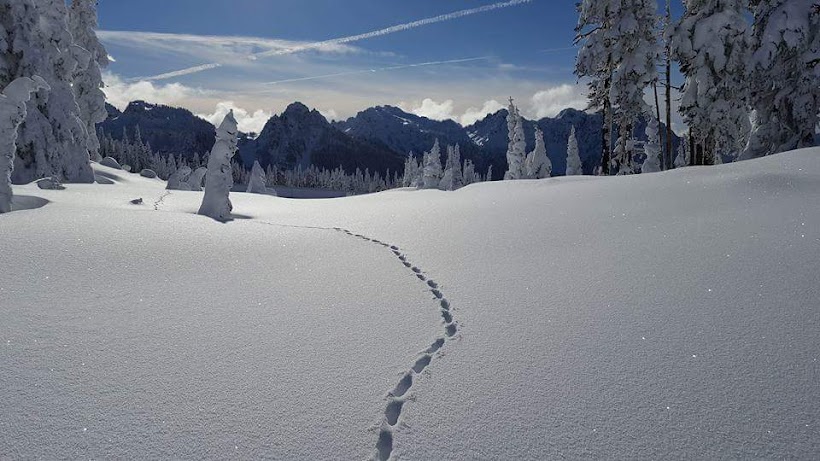
Tracks in the Snow. Photo by John Stoeckl
Thursday, February 6, 2020

Wednesday, July 31, 2019
The Caldera and the Volcano

The lake is deep.
It's clear blue waters run deep and the reflection contrasts remarkably against the natural blue skies.
As a photo-journalist, I got to go up to Crater Lake National Park on assignment. My job was to find out the tourist levels in a summer without smoke and extreme heat. But it was also to find out how the mountain pine beetles are decimating the forests up there.
The winter snows held on this year keeping the park closed well into June, so the tourism had a slow start. But the summer held mild temperatures and clear skies. No fires reported so far (until a few days ago), so tourism was on the rise. I could see it all around me. Happy faces. Families and visitors from across the world coming to see the blue. It has been a beautiful summer so far, and things are looking up.
But climate change has set about a series of events. For one, the summers are warmer and longer. The pine mountain beetle has more time to infest the lodgepole pines, and possibly even reproduce more often creating a larger infestation. The lodgepole pines have had a natural defense against the predator, but the longer summers are taking their toll.
And the white bark pines are now being infested by the pine bark beetle. The pine, which is common around the rim of the lake at much higher elevations has never had to defend itself against the beetle. But with warming temperatures, the beetle is able to move higher in it's pursuit to eat and reproduce.
It is the sign of the times.
 |
| Tourists walk along the clear blue waters of Crater Lake. |
In it's place, the deepest lake in North America. It's called a caldera. Supposedly, the lake does not drain at all but is filled entirely by rain and snow melt. It's more natural and clean than most bodies of water we'll ever come across.
Change happens. And perhaps mother nature will correct this warming climate. Crazy storm systems are already apparent with record floods, violent hurricanes and extensive tornado seasons.
And a lot more fires.
 |
| Author taking a selfie before the lake. |
The lake remains along with bleach white dead stands of white bark pines along a green forest that hasn't succumbed to the infestation. And the blue colors will always bring about the beauty of nature and the illusion that the mountains, the forests and our world around us is perfectly fine.
Which is why we come.
Monday, February 18, 2019
Reflections in the Ice
 |
| Prince Willam Sound Alaska on an icy filled fjord |
Something so profound speaks to me like the droplets of rain on the window of a boat looking out over an ice-filled ocean. The clouds shroud the land in obscurity--so much so one could get lost in it.
I was fortunate to take the journey. I was even more fortunate to get lost in the moment--to take in the landscape and embrace it like a long lost lover. It was a summer where I was hired to be aboard glacier tour boats for no other reason than to interpret the landscape as an interpretive ranger for the U.S. Forest Service. And from these experiences, I've begun drafting a book entitled Reflections in the Ice. The book has 20 chapters and is reaching 50,000 words, which was my goal. I'm now mostly in the editing process and have already begun looking for literary agents and potential publishers.
The book is about change. Primarily about a changing climate where the eulogy is the witness of retreating glaciers in a rugged landscape. It's also a connection to both Alaska and something deep inside of me that had been pushed down, squelched into submission only to finally erupt and blossom with the world around me. A personal journey into the world of glaciers, snow capped mountains, close encounters with bears both black and brown. Living on the banks of the Pacific Ocean where Alaskan ferry boats, cruise ships and float planes pass by on lazy summer days. A place where the cracking and calving of glaciers marks the dramatic element of nature changing nature in a world few people will ever see.
Full of color imagery, personal journeys, quiet reflections and abundant wildlife, Reflections in the Ice is a book one could get lost in...like the droplets of rain on the window of a boat looking out over an ice-filled ocean.
Update #3: I have now reached 50,000 words and am going through my 2nd wave of edits. I've had one publisher approach me for a contract, but it was a bad one in which I declined. I believe in this project! I'm not selling myself short.
I'm also adding a new layer of metaphor to the work that falls in line with H. D. Thoreau and his ability of parables and metaphors. It's a way to handle the more sensitive issues of my past, but also gives me a tool for understanding regarding nature and preservation.
I hope to have the book completed in the next few months. I will keep you posted.
Friday, January 4, 2019
Never Cry Wolf
Reflections and Farley Mowat.
I have been intrigued with Alaska for most of my life. I can say that now because of the year and age that I've reached. My earliest thoughts on Alaska came from a movie that came out while I was in high school: Never Cry Wolf. It was a film based loosely on a book written by Farley Mowat, but adapted to be about a biologist portrayed by Canadian actor Charles Martin Smith. Although the location is up in Canada, the world is the arctic for which I've always related to Alaska.
In the film, biologist "Tyler" goes up to study the wolves and becomes very attached and even defensive toward the world of the arctic and the wolves that inhabit it. The snow on the mountains. The dwarfed firs. The clear glacial lakes. The carved mountain ranges. The tundra. All inspirational to me.
For a long time I contemplated that world while living in the tame confines of the Wasatch Mountains (tame by comparison only). But I romanticized the arctic for many years after I'd first saw Never Cry Wolf in the mid-80s. It remains to this day my favorite film.
I then had the opportunity to move to Fairbanks Alaska for work, but decided to keep my current position and head to Europe. Family was there and I missed them. But while in Holland, I spoke to an American who was stationed in Alaska and spoke of many adventures. Because of my previous job offer, I felt in some way that I had missed a great opportunity back then. Holland was special in its own ways, but every fiber of my being longs for Alaska. The arctic. It's in my blood somehow.
About 9 years later, while living in California, I began a mantra to myself and some of my coworkers. Has the job offer in Alaska come in for me yet? One day, it did. It was almost like providence. It came to me as a gifted present--one I'd longed for for many years. And so about a year later, I moved to Anchorage. My life has never been the same since.
But life takes you on many journeys. Even though I loved Alaska, family and circumstance pulled me away from the place I called home and I found myself in many different places: Illinois, Missouri, Colorado, Utah, Washington and Oregon. Has it been that many? It's baffling to contemplate. But I am a wanderer. Some of those were job related via transfer, some were chosen while others were to become a ranger. I lived and died away from Alaska and longed to return.
In 2015, I was called back to south central where the basis of my book Reflections mostly resides.
I rewatched Never Cry Wolf again tonight, mostly out of inspiration to complete Reflections. I realize more than ever what a completely well done and written film that was. One of the most underrated films of our time. What cinematography! What scripting! What acting! So incredibly well down with metaphors and references, philosophies and imagery--simply by words.
I hope someday to see northern Canada east of the Yukon Territory for which I'm somewhat familiar. I'd love to go see where the wolves are, up north in a world seldom seen by people.
Maybe....
Someday....
I have been intrigued with Alaska for most of my life. I can say that now because of the year and age that I've reached. My earliest thoughts on Alaska came from a movie that came out while I was in high school: Never Cry Wolf. It was a film based loosely on a book written by Farley Mowat, but adapted to be about a biologist portrayed by Canadian actor Charles Martin Smith. Although the location is up in Canada, the world is the arctic for which I've always related to Alaska.
In the film, biologist "Tyler" goes up to study the wolves and becomes very attached and even defensive toward the world of the arctic and the wolves that inhabit it. The snow on the mountains. The dwarfed firs. The clear glacial lakes. The carved mountain ranges. The tundra. All inspirational to me.
 |
| My desk with the film DVD. |
I then had the opportunity to move to Fairbanks Alaska for work, but decided to keep my current position and head to Europe. Family was there and I missed them. But while in Holland, I spoke to an American who was stationed in Alaska and spoke of many adventures. Because of my previous job offer, I felt in some way that I had missed a great opportunity back then. Holland was special in its own ways, but every fiber of my being longs for Alaska. The arctic. It's in my blood somehow.
About 9 years later, while living in California, I began a mantra to myself and some of my coworkers. Has the job offer in Alaska come in for me yet? One day, it did. It was almost like providence. It came to me as a gifted present--one I'd longed for for many years. And so about a year later, I moved to Anchorage. My life has never been the same since.
But life takes you on many journeys. Even though I loved Alaska, family and circumstance pulled me away from the place I called home and I found myself in many different places: Illinois, Missouri, Colorado, Utah, Washington and Oregon. Has it been that many? It's baffling to contemplate. But I am a wanderer. Some of those were job related via transfer, some were chosen while others were to become a ranger. I lived and died away from Alaska and longed to return.
In 2015, I was called back to south central where the basis of my book Reflections mostly resides.
I rewatched Never Cry Wolf again tonight, mostly out of inspiration to complete Reflections. I realize more than ever what a completely well done and written film that was. One of the most underrated films of our time. What cinematography! What scripting! What acting! So incredibly well down with metaphors and references, philosophies and imagery--simply by words.
I hope someday to see northern Canada east of the Yukon Territory for which I'm somewhat familiar. I'd love to go see where the wolves are, up north in a world seldom seen by people.
Maybe....
Someday....
Monday, December 31, 2018
Redwoods
 Far south on the northern coast of California, a tremendous and special grove of trees have thrived. The Redwoods of California. We'd spent the day in Crescent City where seal had come to sun themselves on the rocks in the bay. On our way home we parked in one of the pull offs along the Redwood Highway. Towering Redwoods all around us, just taking one step up the trail made me feel we'd stepped into another world.
In fact, the Redwoods were used in the Star Wars film Return of t
he Jedi.
But they are also famous for something else.
There's a sea bird called the Marbled Murrelet. In the wake of the 1970s when forest management, ecology and nature were reaching new heights, biologists had a puzzling problem. Where does the Marbled Murrelet nest? They've seen them on the ocean water where they spend most of their time. They've seen them fly over the old growth forests such as the Redwoods or the rainforests of the Hoh in Olympic National Park. But no one knew where they nested.
 Then one day, a ranger was way up in a Redwood tree trimming what he thought would be a dangerous limb over the camp ground. He stepped onto another branch to get better footing when he almost stepped onto a Marbled Murrelet chick. The moss created a nest of sorts and feathers from the chicks parents could be seen as well. It was then that they discovered these sea birds won't nest anywhere but in the high canopy of old growth forests.
 I love the Redwoods. They are one of my favorite places to visit. Where else can you find such a special grove of trees, but then drive 10 minutes further west to a sprawling California coastline? But I could literally get lost in the Redwoods for days. No two trails are alike, and yet the trees remind me how small we humans are. It's dizzying just looking upward. Patches of sky appear here and there, but mostly, all you see are towers of red and green.
 And the forest floor is covered in mosses, lichens and ferns.
 And it's home to the Marbled Murrelet among many other animals.
I pointed out the nurse log to my son who was visiting me from back east. I explained that in the Pacific Northwest and up in Canada and Alaska, when a tree falls over, mosses will grow on it and create a living environment for other plants to grow. Seedlings from the Redwoods themselves will gather on that moss and eventually start growing in what appears to be right out of the fallen log. But really it's taken root in the moss and dirt that's gathered. The log will nourish the new growth and eventually decay away giving itself back to the earth. The new growth will take over. The Redwoods are full of these. Nature has a way of taking care of itself in cycles, and the process is happening all around us while we stand in the forest.

Thursday, December 27, 2018
Reflections in the Ice update2
I'm now sitting at 40,000 words and all the chapters have been drafted. My approach now is to start editing the chapters in order, and approach getting them polished for publishing. My current goal is to be ready to submit by February 1.
This has become quite the experience and I have to admit to you as my readers, that this has been a journey of sorts. For those of you that don't know me, I have always wanted to be a nature writer since I first ready Desert Solitaire by Edward Abbey back in the 1980s. I now own a hard copy latest edition of the book. The problem was, I didn't have the true experiences of nature for which to fully turn into a book, my life limited to raising a family and the years I spent in Anchorage, Ketchikan and Juneau.
But when I had to leave the University of Alaska early, where I was pursuing a degree in Environmental Literature, I changed my major to film and television because I had to redo most of my English credits at the new university. For a time I thought I was meant to become a nature environmental documentary filmmaker. That could still be true...
But something awoke in me in 2017. For one, I spent a summer in Olympic National Park and the winter at Mt. Rainier National Park, both as an interpretive ranger. Coupled with my experience as an interpretive ranger in Alaska, the training and experiences there gave me two elements vital to writing my book: fodder for stories and experiences, and the interpretive training for which to approach story telling. Both of these elements have totally changed my approach to writing and made it essential in my completing this book.
And I discovered something within me sometime in 2017 a short time after I had totally lost a close friend to disagreement. I found I was living my life for everyone else and it was time to live life on my own terms. Something deep within me needed to come out. I needed to tell the story. And if I were ever wanting to read about Alaska and nature, I would want Reflections in the Ice to be an option. Of all my books both bought and sought for (Arctic Dreams: Barry Lopez, A Place Beyond and The Glacier Wolf by Nic Jans, Dominion of Bears by Sherry Simpson, Refuge by Terry Tempest Williams, Desert Solitaire and The Journey Home by Edward Abbey, A Sand County Almanac by Aldo Leopold, Travels in Alaska by John Muir among others), I have found that I'd like to read about the experiences I had held and the insights and philosophies I had discovered in my journeys as an interpretive ranger. I would have looked for Reflections in the Ice.
And so I am just a few months away from submitting this book to publishers. I need support! Please advertise this book far and wide and get the word out. I'm confident it will be a wonder work of literature.
This has become quite the experience and I have to admit to you as my readers, that this has been a journey of sorts. For those of you that don't know me, I have always wanted to be a nature writer since I first ready Desert Solitaire by Edward Abbey back in the 1980s. I now own a hard copy latest edition of the book. The problem was, I didn't have the true experiences of nature for which to fully turn into a book, my life limited to raising a family and the years I spent in Anchorage, Ketchikan and Juneau.
But when I had to leave the University of Alaska early, where I was pursuing a degree in Environmental Literature, I changed my major to film and television because I had to redo most of my English credits at the new university. For a time I thought I was meant to become a nature environmental documentary filmmaker. That could still be true...
But something awoke in me in 2017. For one, I spent a summer in Olympic National Park and the winter at Mt. Rainier National Park, both as an interpretive ranger. Coupled with my experience as an interpretive ranger in Alaska, the training and experiences there gave me two elements vital to writing my book: fodder for stories and experiences, and the interpretive training for which to approach story telling. Both of these elements have totally changed my approach to writing and made it essential in my completing this book.
And I discovered something within me sometime in 2017 a short time after I had totally lost a close friend to disagreement. I found I was living my life for everyone else and it was time to live life on my own terms. Something deep within me needed to come out. I needed to tell the story. And if I were ever wanting to read about Alaska and nature, I would want Reflections in the Ice to be an option. Of all my books both bought and sought for (Arctic Dreams: Barry Lopez, A Place Beyond and The Glacier Wolf by Nic Jans, Dominion of Bears by Sherry Simpson, Refuge by Terry Tempest Williams, Desert Solitaire and The Journey Home by Edward Abbey, A Sand County Almanac by Aldo Leopold, Travels in Alaska by John Muir among others), I have found that I'd like to read about the experiences I had held and the insights and philosophies I had discovered in my journeys as an interpretive ranger. I would have looked for Reflections in the Ice.
And so I am just a few months away from submitting this book to publishers. I need support! Please advertise this book far and wide and get the word out. I'm confident it will be a wonder work of literature.
Saturday, December 1, 2018
Reflections in the Ice - Update1
Reflections in the Ice: Glacial Seasons in Alaska.
I've been working on a book for the past few months. Currently I'm sitting just shy of 40,000 words. The book is a personal nature book about the seasons I've spent as a ranger, especially focused on the season I spent on glacier boats. Some of the essays in this blog have in inserted and modified into the book.
The book will touch on all things Alaska: glaciers, mountains, bears, fishing and special places. It'll take you from Ketchikan to Barrow, but focused mostly on south-central Alaska and the Kenai Peninsula. I also have a few essays I'm including from Olympic and Mt. Rainier National Parks.
It's a reflective piece, thus the name. It reflects upon my journey into the wild, my witness to receding glaciers and the effects of climate change. It's also a reflection upon myself. Much like the writings those of you have read here in my blog.
The difference is the format. Everything will be connected and themed together into a long read--the kind of book I would have wanted to read if I had interest in Alaska.
I'll keep you updated.
I've been working on a book for the past few months. Currently I'm sitting just shy of 40,000 words. The book is a personal nature book about the seasons I've spent as a ranger, especially focused on the season I spent on glacier boats. Some of the essays in this blog have in inserted and modified into the book.
The book will touch on all things Alaska: glaciers, mountains, bears, fishing and special places. It'll take you from Ketchikan to Barrow, but focused mostly on south-central Alaska and the Kenai Peninsula. I also have a few essays I'm including from Olympic and Mt. Rainier National Parks.
It's a reflective piece, thus the name. It reflects upon my journey into the wild, my witness to receding glaciers and the effects of climate change. It's also a reflection upon myself. Much like the writings those of you have read here in my blog.
The difference is the format. Everything will be connected and themed together into a long read--the kind of book I would have wanted to read if I had interest in Alaska.
I'll keep you updated.
Tuesday, September 4, 2018
Grave Creek
I'm shifting gears. A little bit of history.
Those that know me know that I love to delve into historical places, especially when it comes to the old West: Ghost towns. Vintage locomotives. The history is darkly vibrant. Or vibrantly dark. I seek to hear the whispers of the past. What stories would they tell?
I drove up to Sunny Valley and stopped at the Applegate Museum which I was quite impressed with, with interpretive displays of the Applegate Trail and its history. Just down the road from the museum is the covered white bridge, which crosses Grave Creek.
According to HMdb.org, or the Historical Marker Database, the year was 1846. The Crowley Family on their last leg of the Applegate Trail (southern alternate route to the Oregon Trail) heading north stopped at the creek to bury their daughter, who around the age of 15, died of Typhoid fever. They buried her just beyond the bridge. Due to the event, the creek was named Grave Creek.
I stood at the edge of the creek, looked through the covered bridge and wandered over to Martha's grave site. My mind tends to wander in moments like this. What if you could take away the bridge, the roads, the houses and put yourself back to 1846? What if we took away our modern conveniences of heated (or air conditioned) vehicles that can travel 70 miles an hour on the interstate getting us 120 miles in just 2 hours? What if we had to be on foot, or on horseback, pulling a wagon at a whopping speed of 3 mph, taking us months to cross the Western territories through the heat of summer and the cold of winter? What fears would we experience? Native Americans fighting for their homeland? Predators such as wolves, bears, or cougars? Or what about a worse fear, such as starvation, hyperthermia or just plain being lost in the wilderness?
 Standing there at the face of the grave of Martha Crowley, I could hardly imagine with a family's hopes and dreams of completing the journey to the promised land of Oregon, setting up a farm, finding prosperity and watching your daughter grow into a woman, get married and bring grand children into their lives. But that's not the history. So much of it is skewed. So much forgotten. All that is left is the grave site, and the name of the creek, and a covered bridge that marks a moment, a long forgotten moment of history to those who pass by on Interstate 5 with only the distant view of a white wooden covered bridge in the distance--hardly noticeable unless you look.
Looking out over the hills imagining their time in 1846, and looking down at the deep green mossy creek and how the wagon train must have crossed it, there were no whispers. There were no stories. Just a gentle breeze of a long forgotten moment on a late summer day in southern Oregon.
Those that know me know that I love to delve into historical places, especially when it comes to the old West: Ghost towns. Vintage locomotives. The history is darkly vibrant. Or vibrantly dark. I seek to hear the whispers of the past. What stories would they tell?
I drove up to Sunny Valley and stopped at the Applegate Museum which I was quite impressed with, with interpretive displays of the Applegate Trail and its history. Just down the road from the museum is the covered white bridge, which crosses Grave Creek.
According to HMdb.org, or the Historical Marker Database, the year was 1846. The Crowley Family on their last leg of the Applegate Trail (southern alternate route to the Oregon Trail) heading north stopped at the creek to bury their daughter, who around the age of 15, died of Typhoid fever. They buried her just beyond the bridge. Due to the event, the creek was named Grave Creek.
I stood at the edge of the creek, looked through the covered bridge and wandered over to Martha's grave site. My mind tends to wander in moments like this. What if you could take away the bridge, the roads, the houses and put yourself back to 1846? What if we took away our modern conveniences of heated (or air conditioned) vehicles that can travel 70 miles an hour on the interstate getting us 120 miles in just 2 hours? What if we had to be on foot, or on horseback, pulling a wagon at a whopping speed of 3 mph, taking us months to cross the Western territories through the heat of summer and the cold of winter? What fears would we experience? Native Americans fighting for their homeland? Predators such as wolves, bears, or cougars? Or what about a worse fear, such as starvation, hyperthermia or just plain being lost in the wilderness?
 Standing there at the face of the grave of Martha Crowley, I could hardly imagine with a family's hopes and dreams of completing the journey to the promised land of Oregon, setting up a farm, finding prosperity and watching your daughter grow into a woman, get married and bring grand children into their lives. But that's not the history. So much of it is skewed. So much forgotten. All that is left is the grave site, and the name of the creek, and a covered bridge that marks a moment, a long forgotten moment of history to those who pass by on Interstate 5 with only the distant view of a white wooden covered bridge in the distance--hardly noticeable unless you look.
Looking out over the hills imagining their time in 1846, and looking down at the deep green mossy creek and how the wagon train must have crossed it, there were no whispers. There were no stories. Just a gentle breeze of a long forgotten moment on a late summer day in southern Oregon.
Thursday, August 9, 2018
Smoke at the Bolan Mountain Fire Lookout
 |
| Bolan Lake as seen from below the fire lookout. |
But the valley was somewhat obscured here as it is in my own life. Smoke from the Nachez fire just south across the border in California shrouded the valley all around us as a fellow ranger and I began our trek up to the Bolan Mountain Fire Lookout above the lake. It was mid morning, 70 degrees, and our hike would take us 1.7 miles to an elevation of 6242 feet.
 |
| Indian's Paintbrush |
 |
| The trail to Bolan Mountain Fire Lookout |
The trail continued upward with switchbacks changing our direction often until we went over the saddle and down into the adjacent valley. More paths intertwining with each other. The trail hit a junction where we had the option of continuing on to Kings Saddle just south of Grizzly Peak, or turn right and head down a small valley and back up toward the lookout.
Pondering the mindset of people over time and the naming of Grizzly Peak. Oregon hadn't seen grizzlies since the early 1900s--the result of heavy predator hunting by pioneers of the time. Still the name gives one pause as to its origins. I wondered what these mountains may have been like back in the 1800s, when hiking similar trails was more out of necessity rather than recreation, and the fear of America's monarch of the wild, the grizzly bear, was among the greater fears of being present in these rugged mountains. It was the mindset back in the day to kill all bears and make the mountains safer. Many still feel that way. But the whole concept that a keystone species like the wolf and the bear are actually better for the environment making forest ecosystems stronger wasn't considered until recently. Discussions of returning grizzlies to the Cascades in Washington and other places are now at least being talked about.
Change happens.
I have to wonder if some day I will walk these mountains with a feeling of danger and wariness with the idea grizzlies could be here. The thought excites me. We look for change in the drywalled and concrete canyons of the halls of government, but it's here in the mountains that the real changes are inflected.
At trails end, we found the road to the lookout and made our way to the top. Bolan Mountain Lookout stood on the top of the ridge, as most lookouts do, for the purpose of detecting fires. Replaced by modern technology of air craft and other resources, many fire lookouts have been decommissioned. They either stand empty, boarded up and forgotten, or they become cabin rentals. Bolan falls into the latter of these with its latest occupant having picked up the key the day before on her two day adventure.
 |
| Bare necessities inside the Lookout. |
All the modern conveniences of life.
While standing on the decking and looking both inside the lookout as well as at the smoky views around me, it gave me a moment to wonder what the summers were like for fire lookout rangers. Most stayed in these primitive settings for months at a time with little contact with the outside world besides the occasional radio checks and shopping trips for food. Solitude is what I think of. No internet. No cellphones. Just the quiet of being on top of a mountain. Viewing a lazily soaring red tail hawk. Looking for fires. Experiencing the violent rush of lightning storms crashing all around and then looking more aggressively for fires afterward.
Then returning to the quiet.
 |
| Author standing on the decking amid smoke filled skies. |
To be someone who is willing to take a long moment to pause in the vast geologic expanse of time and open yourself up to become something more profound--so profound that words cannot express it. Nothing can. To see the world differently. To see the mountains for what they are. To see the bears for what they are. To allow yourself to breathe in the world around you in its stillness and listen to the voice within.
Change.
For today, the world is obscured. The paths here are intertwined and it's hard to see my way ahead. It's obscured not only by the smoke that surrounds the peaks around this fire lookout, but also by the limited time spent here. For being here for just a moment in a day is much less significant than an entire season, and a season much less than a lifetime. But we all play our part. Each of our life's experience changes us in minute ways, sometimes as quiet and unseen as the carving of sandstone over decades, or as explosive as the strike of lightning across dry forests in southern Oregon engulfing it in smoke and fire. Eventually the smoke clears and a new way forward is seen. The burn scars remain but regrowth happens. Time heals all wounds.
My moment has ended. It's time to head back down the mountain. Some day I'll be back here, or perhaps to another fire lookout for I'm hooked. Maybe I'll stay for a night or two. Maybe I'll stay for a season.
It might even change me for a lifetime.
Saturday, August 4, 2018
The Wandering Ranger
I'm looking for new inspiration to write, to share and to illustrate the deeper thoughts and feelings within me.
 On a quiet Sunday evening while working on my book, I find myself taking the time away from writing to think about all the adventures I have been graced to witness in my life. Not that I'm gloating but rather that I feel blessed. I've been to Canada and Mexico, driven the Alaska Highway 6 times, lived in Germany and Holland and have traveled as far as the middle eastern country of Kuwait. Each place has had it's unique qualities and differences from one another. Primarily, those times when I found myself in desert, I longed for the mountains. Or when I was in the mountains, I longed for the ocean.
My hero is Edward Abbey. I first read his book when I was a teenager in high school. My 10th grade biology teacher had given my brother and I the book as an end of year gift. He didn't do that for many, but I guess he felt a connection with us. I read the book. I was intrigued with the experiences a park ranger could have in Arches National Park. The crudeness. The dry humor. The passion. When I sought to be a writer back in the 80s and 90s, I always found myself falling way short of things to write about. After all, I wasn't a park ranger in a pretty awesome place like Arches National Park. What would I have to write about?
 But writing is about experiences. It's what is in us each and every day. My writing was limited to occasional attempts at journaling typically in the fall season when I felt inspired. But ultimately, I had been only trying to emulate my hero. Everything crumbled. I prayed to become a writer, and the only response I got was "write!". But I wasn't writing for myself. I was writing to perform. Within that, it was never me. I had lost my voice.
My voice came when I was hired as a ranger in 2015 aboard the glacier boats in Prince William Sound, Alaska. I started by journaling my experiences. As I reread my journal of that time, I recognize quickly that I had begun with the same mistakes of the past: to perform. But over time, I discovered 30, 50 or 100 pages in, that what I had been writing was in me. I was finally pulling out from the depths of my soul my inner thoughts and passions. On occasion, I even found passages I was truly proud of.
 Since then, I found myself on a journey I didn't expect. I couldn't find work locally in southern Oregon, but quickly got picked up by Olympic National Park with job offers from 4 other national parks or monuments that same spring. I went to Olympic and guided people on nature walks, patio talks, and campground presentations. I lived on a lake with Western Red Cedar and Douglas Fir as my primary protection from the world around me. My summer was filled with awe and wonder with the changing weather, the high altitude views and the ability to be in wilderness. I'd move on to Mount Rainier where I lived in a 19 foot travel trailer with snow falling, leading snow shoe hikes atop of 17 feet of snow, and sitting in a small museum looking out at the winter around me.
Glaciers, mountains, ocean and temperate rainforest. They were a far cry from the desert solitaire of Arches National Park. But it was my world, not Abbey's. I was a wandering ranger. I had found my voice.
And with that a new inspiration to write, to share and to illustrate the deeper thoughts and feelings within me.
 On a quiet Sunday evening while working on my book, I find myself taking the time away from writing to think about all the adventures I have been graced to witness in my life. Not that I'm gloating but rather that I feel blessed. I've been to Canada and Mexico, driven the Alaska Highway 6 times, lived in Germany and Holland and have traveled as far as the middle eastern country of Kuwait. Each place has had it's unique qualities and differences from one another. Primarily, those times when I found myself in desert, I longed for the mountains. Or when I was in the mountains, I longed for the ocean.
 My hero is Edward Abbey. I first read his book when I was a teenager in high school. My 10th grade biology teacher had given my brother and I the book as an end of year gift. He didn't do that for many, but I guess he felt a connection with us. I read the book. I was intrigued with the experiences a park ranger could have in Arches National Park. The crudeness. The dry humor. The passion. When I sought to be a writer back in the 80s and 90s, I always found myself falling way short of things to write about. After all, I wasn't a park ranger in a pretty awesome place like Arches National Park. What would I have to write about?

My voice came when I was hired as a ranger in 2015 aboard the glacier boats in Prince William Sound, Alaska. I started by journaling my experiences. As I reread my journal of that time, I recognize quickly that I had begun with the same mistakes of the past: to perform. But over time, I discovered 30, 50 or 100 pages in, that what I had been writing was in me. I was finally pulling out from the depths of my soul my inner thoughts and passions. On occasion, I even found passages I was truly proud of.
 Since then, I found myself on a journey I didn't expect. I couldn't find work locally in southern Oregon, but quickly got picked up by Olympic National Park with job offers from 4 other national parks or monuments that same spring. I went to Olympic and guided people on nature walks, patio talks, and campground presentations. I lived on a lake with Western Red Cedar and Douglas Fir as my primary protection from the world around me. My summer was filled with awe and wonder with the changing weather, the high altitude views and the ability to be in wilderness. I'd move on to Mount Rainier where I lived in a 19 foot travel trailer with snow falling, leading snow shoe hikes atop of 17 feet of snow, and sitting in a small museum looking out at the winter around me.
 Glaciers, mountains, ocean and temperate rainforest. They were a far cry from the desert solitaire of Arches National Park. But it was my world, not Abbey's. I was a wandering ranger. I had found my voice.
And with that a new inspiration to write, to share and to illustrate the deeper thoughts and feelings within me.
Tuesday, July 31, 2018
A Morning Visitor
 We played a staring game the gray fox and I for some time. He at times would change position by moving to the other side of the tree, then the staring match would continue.
 I, on the other hand, remained still and quiet curious what my new found friend would do. I could tell he was both cautious and curious at the stranger in black and green. I always wonder what the natural world think of us loud and obnoxious humans. This human would remain quiet and watch.
The gray fox made his way down to the road, stopping and watching. He crossed the road and again stopped to stare. His curiosity of me was getting the best of him. He cautiously edged closer and closer bobbing his head to make sure I wasn't on the attack, stopping just beyond the gate to the ranger station compound.
As our staring match continued, I have to wonder about the natural world and its clash with human development. To the fox, the forest with its predators, seasons, food and protection is all they need to live a relatively fruitful life. The human animal is different. We build shelters creating artificial heat and cold, changing our own environment to live well beyond the needed core temperature environment of near 98 degrees. Roads are developed. Loud vehicles pass. Cities take over forests and deserts and mountains. Ecosystems are encroached upon and removed. Animals scatter from their natural environment sometimes behaviorally adapting to new habitats for which to survive. For this fox, he lives in the woods of a Forest Service compound where buildings and trucks and people frequent. We've learned to live together in some unique way.
I found myself in deep contemplation at the chance to see a wild animal at the gate of the forest district compound. A rare occurrence I can assure you! Why was he there? Was he always there?
I thought about the fires that had engulfed the region. Taylor fire near Grants Pass. Klondike fire near Selma. Nachez fire down just south of Page Mountain in California. I was literally surrounded by fires and the daily smoke told the story. Dense smoke that made even the smoggiest cities jealous engulfed the entire region. Was this fox homeless? Displaced from the shelter and forests it knew and called home? Maybe he was only here for survival. Maybe his curiosity in seeing me was more merely having never been close to people before. I felt a certain profound sorrow at this as I stood there at the ranger compound looking back at my new found friend.
 Within a short time, the fox retreated and went back into the woods for which he came, not even looking back. I found myself a little in awe of the situation. Perhaps it wasn't as exciting as seeing the black bear in Alaska with her cubs. Nor was it quite like running into a moose on a winter morning outside my front door. But anytime I get to experience some level of wildlife, I stand in wonderment. to experience even that of the elusive fox.
I looked in the direction of his departure for some time following, but he was gone. I wonder if he'll be back on some other morning. I turned to go only to be greeted by the morning sunrise. Life is pretty amazing.
Saturday, April 28, 2018
Reflections in the River

Leaving my familiar territory of Western and Mountain Hemlock that I was so used to in the Olympics as well as Mt. Rainier, I quickly had to adjust to the tall and spread out Ponderosa forest mixed with Douglas Fir, White Fir and a cedar I wasn't familiar with. Mixed cones of Ponderosa, sugar and Douglas scattered the trail, and after a winter of inactivity, pine needles scatters obscuring the trail often times losing our way.
 We made our way down to the head waters of Wood River where the clear cold spring waters erupted from beneath the earth to create the river. The spring filtered through rock is clean enough to drink. Rare in this day and age. Basalt and pumice, evidence of the eruption of Mt. Manama can still be seen scattered everywhere, the pumice creating a green tint to the river. The spring is said to come from Crater Lake, many miles away. I suppose the waters have to go somewhere.
Everything is within a cycle. We see seasons of warm summers where rivers retreat, animals thrive, and life continues in a lazy way. In autumn, bears push hard for their last chance calories before hibernation and elk and moose rut hard for the chance of continuing on their genes while the leaves of trees change color ready to fall to the earth to pass on their own nutrients. In winter, the world rests mostly, although life teams in full concert beneath the snow as mice, picas and other creatures continue on. Then spring brings renewal. We humans are mostly desensitized creating environments that match our own luxury rather than adapting to the world outside. But we too have a cycle. We live....we die... Perhaps our own renewal happens on a different place, a spiritual one.
Every forest is unique. If you take the time to listen, you'll hear something different, or that of nothing at all. But in it's quiet, depth of solitude unmatched anywhere else. I'm find I'm happy to have been able to witness but for a day a different place, a different sound, a different solitude. I'll be back and often throughout the summer shaping young minds into hopefully seeing the reflections I do in nature, and yet obscuring the private reflections within my own life.
Wednesday, July 5, 2017
Just another Volcano

“The Only Thing That Is Constant Is Change -” - Heraclitus
Change seems to be the only element that is constant in our world of day to day. Even the slightest change in what would normally be a mundane work week seems to rear its face from time to time. Taking a group on a private tour to Mt. St. Helens, I expected a tremendous change to be prevalent. Sometimes change is huge. Other times its as subtle as a difference in the breeze. Sometimes the subtlest of change can be the biggest difference.
Mt. St. Helens erupted on May 18th, 1980. Since March of that year, it began giving a lot of clues: earthquakes, and small eruptions. On the morning of May 18th, geologist David A. Johnston was out on the northern ridge observing the mountain as he'd done many times before. One big difference is that the mountain had bulged out 450 feet. At 8:26 a.m., the entire north face collapsed in what would be the largest landslide in recorded history. Then the eruption followed spewing upward and northward and blasting and burning everything for miles. It would be the last time David Johnston would be seen again. 56 others would perish as well.
As I drove my group eastward on highway 504 toward the Johnston Ridge Visitor Center, I had expected full recovery. What I saw shocked me. In the act of natural progression, in simple terms, lichens and mosses gather on the exposed bare rock and soil, and make more soil. Pioneering plants will seed and grow on that weak soil and add nutrients to it staging it for the next levels. Shrubs like alders and willows will begin growing. Eventually deciduous trees will sprout, and finally coniferous trees will take over. In Washington state, typically those trees are Douglas firs, western red cedar and western hemlock in the subalpine regions. I had expected these deep green forests and trees to have made a young but fruitful recover over 37 years. What I found was astounding. For at least 14 miles out from the mountain remained mostly barren land. The volcano had literally sterilized the land when the heat and ash blew through at approximately 300 miles per hour stunting the natural progression of regrowth. Most of the rock remained exposed. Bleached logs lay throughout the terrain. Only in the valleys and more distant hillsides were there new signs of life. Alders mostly gathered in the valleys, their rippled leaves apparent. Young forests had regrown only where the land was protected from the blast due to natural geographic layout like cliff sides facing away. New lakes were formed and rivers rerouted. But for a western Washington terrain, it felt like I had landed on a distant planet at some other part of the galaxy.

But although stunted, there was change. No more did one see the rivers of ash, or the mudflows pushing hard down rivers. No more could one see a coned mountain, but a cratered opening. And regrowth was happening. It will be many years before this land returns to the thick green forest known commonly in this region. For us humans, it may be beyond memory. In geologic times, it is merely the blink of the eye.
Thursday, January 26, 2017
Looking for Bigfoot
We bush whacked into the woods behind our RV pad near Ashford, Washington. Andrea and I, looking for trail but only finding pathways where deer and other animals have passed previously. That day was cloudy, and a grayness seemed to converge over all things, emphasizing the terrain into a misty glow. We crossed over an old railroad track, long forgotten in which moss covered the medal rails and trees with diameters up to 2 feet had grown between the ties. We stepped carefully, trying not to trample ferns and other flora that was mostly dormant during this winter month of January.
Everything was wet. Recent rains and snows had left things damp and dark. We passed through a meadow, a forest fire of years past and recovering with new pines poking up with new life. Andrea walked on with determination, dreams of finding treasures: a railroad spike, coins from the 1800s or other pioneer antiquities of days long forgotten. I too was looking for treasure, but of a different kind. I was looking for something so profound that even as I write these words, I cannot define them. Something about the depth of life, and the rebirth of spirit.
I was also looking for Bigfoot. Sasquatch. That myth that seemed to be synonymous with the Pacific North West and its deep plush forests. More Bigfoot sightings have been reported in Pierce County Washington, than any other place in the state. Some close to where we were. Although still on the fence as to the true existence of the mythical creature, I couldn't help but wonder if I'd have a chance to experience first hand and prove within myself its true existence. So I kept watch. Looking. Waiting.
We reached a small stream. The waters of snow and glacier melt kept it too swift and deep for easy (or dry) crossing, and Andrea and I resigned to staying put for the time, the sound of the rapid waters enveloping our ears. Our eagerness to cross the stream and see what is beyond the banks, into the woods and the mystery of the unknown was almost too strong to ignore. I kept my vigilance of looking around as if expecting some dark haired yeti to be standing there, looking back at us in the same curiousness, then lumbering off into legend. But the spaces between the thick pine forest remained still. But I couldn't help but get a sense of energy about me as if we weren't alone. It was as if all of my senses were heightened for the first time in a very long time. The Jedi force was working it's magic within me as if even the movement of a snail would be known at that very time and place. Every fiber of my being was reawakened. I felt alive.
But with no treasure to be found, and the waning light fading, we made our way back through the forest, across the old burnt meadow and on to our quiet neighborhood of home. Satisfied we'd experienced something, but unable to define exactly what, we knew that soon we'd be back on our search for treasure, for solitude or for life. Or perhaps to discover a myth out there or within ourselves that had been previously unsolved.
Everything was wet. Recent rains and snows had left things damp and dark. We passed through a meadow, a forest fire of years past and recovering with new pines poking up with new life. Andrea walked on with determination, dreams of finding treasures: a railroad spike, coins from the 1800s or other pioneer antiquities of days long forgotten. I too was looking for treasure, but of a different kind. I was looking for something so profound that even as I write these words, I cannot define them. Something about the depth of life, and the rebirth of spirit.
I was also looking for Bigfoot. Sasquatch. That myth that seemed to be synonymous with the Pacific North West and its deep plush forests. More Bigfoot sightings have been reported in Pierce County Washington, than any other place in the state. Some close to where we were. Although still on the fence as to the true existence of the mythical creature, I couldn't help but wonder if I'd have a chance to experience first hand and prove within myself its true existence. So I kept watch. Looking. Waiting.
We reached a small stream. The waters of snow and glacier melt kept it too swift and deep for easy (or dry) crossing, and Andrea and I resigned to staying put for the time, the sound of the rapid waters enveloping our ears. Our eagerness to cross the stream and see what is beyond the banks, into the woods and the mystery of the unknown was almost too strong to ignore. I kept my vigilance of looking around as if expecting some dark haired yeti to be standing there, looking back at us in the same curiousness, then lumbering off into legend. But the spaces between the thick pine forest remained still. But I couldn't help but get a sense of energy about me as if we weren't alone. It was as if all of my senses were heightened for the first time in a very long time. The Jedi force was working it's magic within me as if even the movement of a snail would be known at that very time and place. Every fiber of my being was reawakened. I felt alive.
But with no treasure to be found, and the waning light fading, we made our way back through the forest, across the old burnt meadow and on to our quiet neighborhood of home. Satisfied we'd experienced something, but unable to define exactly what, we knew that soon we'd be back on our search for treasure, for solitude or for life. Or perhaps to discover a myth out there or within ourselves that had been previously unsolved.
Wednesday, December 14, 2016
Deep Snow on the Mountain
My journey began a few days previous when I had arrived at Mt. Rainier for the winter season. Driving in from Ashford and through the park gate, it was like I had entered a new world with the rain and sleet changing to snow, and the clear pavement becoming a sheet of white ivory ice beneath my tires. Driving at slow speeds through coated firs and pines, around slick curves and steep drop-offs, it took me nearly 20 minutes to arrive at the sleepy village of Longmire, the hub of Mt. Rainier National Park.
Snow fell heavily and had already blanketed everything around the historical administrative building, the museum and various other buildings. Pines would on occasion cascade and slough off piles of snow from their limbs to the ground, unable to carry the weight any longer. They looked as if God had poured whipped cream over their boughs so that only shadows of pine green, almost black could be seen beneath the snow. But a strange quiet rested upon the place as if the snow absorbed everything and blanketed the world from all sound.
I had been told it was a normal year for snow, which hadn't been seen in these parts for years. Climate change has receded the "normal" amount of snow leaving many places more rainy, and glacial real estate at a declining minimum. The very next day, we went from Longmire to Paradise, an elevation of over a mile up. The skies were so blue, one had to squint just to look at it, and in contrast with the new fresh white, it was a perfect day to be on the mountain.
 |
| Cascade fox tracks in the virgin snow. |
Donning snow shoes and sunglasses, I ventured out into old trail and virgin snow, through thick stands of subalpine fir and mountain hemlock, so thick with new snow you could hardly see the boughs. Crystal snow reflected the rays of the sun, but seem to reflect even more my own sense of self. A Cascade fox's tracks could be seen tracking from tree to tree, sometimes following my path (or maybe I was following his path), or breaking off in search for sustenance beneath the snow. I felt in awe as the shuffle of my snow shoes through thick snow made me feel small and insignificant in the powerful shadow of the great mountain.
Eventually, I would make my way to a lookout and see the mountain in her majestic stature, waiting... Waiting to erupt in a long overdue volcanic explosion. Waiting to change our world and what we know of it, as Mount St. Helens once did and push lava and ash across western Washington wiping out nearby towns and maybe erasing half of Tacoma. Or maybe, just continuing it's restful sleep unable or unwilling to awake in our lifetime.
I wander back. As J.R.R. Tokien once wrote: "Not all who wander are lost". I continue to listen to the shuffle of my snow shoes in the deep virgin snow. My wandering was always with purpose, albeit not always with direction. For in wandering, we often find ourselves in self discovery rather than journeying to a specific location. But perhaps I am lost. Perhaps it is only the mere reality of my perception of the world around that I am familiar with, but subconsciously, I have no idea where I am. I wander onward as those thoughts of philosophy will have to wait, at least for the moment.
In the meantime, the sun fades into the mountains on our own journey around it, the cascade fox will likely burrow into the well of a tree and find it's sleep. I for one have to leave this place, if not for a night or two. For I will be back many times, on many back country journeys, and perhaps I too will find my way home.
 |
| Snow shoe trail bordered by Cascade fox tracks. |
Monday, December 5, 2016
Anchored into Place (written 2010)

I arrived in Anchorage in late September,
and with the sun only appearing mostly to the south, it felt like I had settled
upon the top of the world. With
exception to the hearty few that clung to the barren branches, the deciduous
trees had already lost most of their leaves, and the season’s shade cover was now
left scattered and dead on the earth floor.
In later years, I would find myself earlier in the season with tripod
and camera, heading up to the nature center in Eagle River and taking colorful
hues of red, yellow and orange, mixed in with the greens of spruce, and other
coniferous trees; scenery that would parallel New England. Fall, being among my favorite seasons, I was
happy to arrive in this new destination I would later call my home. Anchorage had become, like many who’d arrived
before me, a chance for a new life. I
stood intrigued with the dust of snow on the mountains around me, and a
mystique began to grow in wonder as I thought about the wilderness beyond the
metropolis of concrete canyons around me.
I hadn’t come to be a part of Anchorage, but of Alaska, and the lands
that surrounded the largest city in the state.
As I settled into my new home, I began to wonder about living in such a
large city and how it co-existed with the natural environment. Has humankind driven out the wildlife, or has
nature found a way to work within and coexist with man? How far would I have to venture forth to see
the wilderness that I had been longing for; that wilderness that filled my
dreams and romanticized my imagination.
I had to start somewhere to seek and sort it all out. So long as I lived in the city, it would be
my foundation, anchoring me to the opportunity to explore within and beyond the
city limits. For me, the adventure was
only beginning.
Despite the population of over 260,000
people, Anchorage is teaming with wildlife.
Black and brown (grizzley) bear, moose, dall sheep, wolves, coyotes,
lynx, beavers, bald eagles, Canadian geese, as well as other migratory and
resident birds can be seen from time to time within and around the city. The most common sightings of wildlife for me
were moose. It wasn’t uncommon to see a
gangly moose sauntering down Northern Lights boulevard, or standing idly in someone’s
front yard. The first season I lived in
Anchorage, a moose cow wandered into my yard one weekend before the snows
started falling, and took a nap there for a few hours. I didn’t take it personally. I figured this had been her home long before
I got there and in some strange sense I saw a touch of wilderness in my own back
yard. She would come back into my life
at seemingly strange and significant moments of my life as the seasons went
by. In a way, she became a long and
trusted friend that I would remember the rest of my life.
The
Chugach Mountains dominate the city, and I learned quickly it gives the
inhabitants there methods of measurements in several ways. Because the mountain range covers the entire
eastern side of the city, it provides a compass for which to find your way
through town. As a barometer, it also
provides the announcement that winter is on its way. The peaks will begin showing a snow line that
during the fall, will continue to descend down the mountain. When it reaches the valley levels, Anchorage
will see its first taste of snow for the winter. The locals call this “termination dust”,
terminating summer and announcing that winter has indeed arrived.
Deep
within the winter months of November, December and January, the sun peaks out
over the southern horizon, remaining low in the southern sky as if nothing more
than to give the residents of Anchorage a reminder that the light of the sun does
exist during the darkest months. It
rises for only a short 4 hours on the winter solstice, December 21st, coming up
at around 10 a.m. and setting before 2 p.m. The lack of sunlight seems to add to the
winter cold that shrouded the area.
As winter set in, I found myself
habitually watching. Despite the fact I
lived in a regular neighborhood on the east side of town with not much to look
at besides the neighbors across the street, I found myself looking out the
window in constant vigil as if something would happen: a snowfall, a wandering bear, the return of
my moose, or some other adventure I wanted to be a part of. I didn’t want to miss a thing. On top of my evening vigils, I found habit
enjoying coffee on a Saturday morning looking out at the falling snow,
contemplating life, and looking at the change in mystery around me in wonder
for much the same reasons. I also wanted
to find meaning in it all. I wanted this
world to change me, cover me just as the snows did all around my little cave
called home and immerse me in the wilderness of the unknown. But I wasn’t in the wild. I was in the city where humankind has
replaced the natural habitats of the native creatures with skyscrapers, houses,
bike trails, airfields and hundreds of miles of road. These things were the comforts and
survivability of humankind, but in a way I saw them as flaws, those things that
have scarred the land and laid waste to what was. As I watched the snow come, it brought nature
back close to me. It falls where it will
and covers all of the man-made flaws in the world around us. It blankets us in change, and enables us to
hibernate in some way from the contrasts of vivid reality.
Late one evening, I stopped to look
out the front window at the night sky.
It was glowing from the city lights and enhanced by their reflection
upon the snow. It had been a clear
night, cloudless, and stars could be seen through the city haze. There were also two green trails not unlike
aircraft smoke trails that glimmered dully across the sky. I hadn’t seen the Northern Lights before, and
I suspected we had just been introduced.
I wanted to see more. I jumped
into my truck and headed a few miles north of town to Arctic Valley drive, a
road primarily controlled by the U.S. Army.
It was far enough away from the city lights to give me a better view of
the sky. As I got out of the truck and
looked up, the two green trails had mutated into shimmering streams of crystal
white that primarily formed what looked like a huge cone, a floating teepee of
sorts. It was like I was looking up into
the center of the cone and could even see stars within the narrow funnel at the
top. I looked down for a moment long
enough to notice the world around me was glowing brighter. I looked up quickly to see the cone had
changed to what looked like shards of ice and glass showering down upon me as
if it would crush me in certain impact.
The awe-inspiring act lasted only but a moment before retreating back
into long streams of light, ever changing, reflecting upon my very existence.
The winter of 2001/2002 was the
longest in memory, when thinking of actual cold and snow. Although the initial dustings of snow
occurred in September, the first real storm to substantially remain hit the
Anchorage bowl on October 11th.
We didn’t see the bare earth again until May the following spring. It was also the winter that shut the city
down for 2 days. Sunday March 17th. Even after two years in Alaska, I still found
myself on my evening ritual of looking out the front window. I turned off the lights in the house and glanced
out at the street below. Everything
seemed quiet. Deep snow blanketed the
yards of the neighborhood while piles stacked up from the constant need for
plowing. The houses seemed dark, a ghost
town, as if I were the only one there.
 Then I saw movement across the
street in the dark between the houses.
Looking closer, I discovered it was my friend the moose cow. I hadn’t seen her in over a year and wanted
to go out and see if she had some stories to tell. I went out on my deck for a closer look, and
not only received a better visual, but an audio impact as well. The sounds of hooves beating the snow-packed
ground along with her snorting could be heard as she seemed to be aggravated by
something. She was facing a young
sapling that stood in the yard near the street as if the tree were a
threat. She moved to the other side of
the tree by the road, but never gave up her stare of the threatening oak. As if startled by something new, she ran a
full circle around the tree and disappeared back into the darkness between the
houses. She didn’t even say good bye.
Then I saw movement across the
street in the dark between the houses.
Looking closer, I discovered it was my friend the moose cow. I hadn’t seen her in over a year and wanted
to go out and see if she had some stories to tell. I went out on my deck for a closer look, and
not only received a better visual, but an audio impact as well. The sounds of hooves beating the snow-packed
ground along with her snorting could be heard as she seemed to be aggravated by
something. She was facing a young
sapling that stood in the yard near the street as if the tree were a
threat. She moved to the other side of
the tree by the road, but never gave up her stare of the threatening oak. As if startled by something new, she ran a
full circle around the tree and disappeared back into the darkness between the
houses. She didn’t even say good bye.
After a moment of silence, I
returned to the warmth of my living room resuming my evening duties. Moments later, I glanced out the window to
see the initial flakes gleaming within the streetlight. Within minutes, they fell thick and
heavy. It took no time for the plowed
and tired-scarred road to be covered in a thick white-gray blanket. It continued to snow deep into the night. I got up once in the middle of the night to
discover it was still snowing. By the
time I woke in the morning, over 2 feet of snow had fallen. Everything seemed different. The world had indeed changed. Roads were gone. Houses were hobbit holes. Cars were mole hills. The 4 foot chain-link fence in my side yard no
longer existed, completely buried in the glacier that seemed to have fallen
overnight. Schools were closed. Grocery stores and businesses were
closed. The military bases were
completely shut down. The only businesses
that remained open and employed for the next two days were fire, police and
medical services. And snow plows. They wouldn’t reach my meager street for over
a week.
I
sat in wonder at the event of the past 12 hours, the moose, and the
snowfall. My moose must have felt the
oncoming storm and was gearing up for the impact. It all seemed connected somehow to the
natural order of things. Moose come
equipped with waterproof fur shielding the cold along with long gangly legs
giving them the tools to tramp through thick snows with heights taller than
most animals to forage into the higher branches in search for winter
sustenance. Mankind, on the other hand,
has had to use brain and technology to find shelter and transportation, and
warm clothing to survive winters in the arctic while destroying the very
territory that remained with the moose for thousands of years before the
onslaught of human entrapment. She had
warned me of the upcoming snowfall. I
also began to wonder why she had infringed upon my neighborhood. Or was it I that was infringing on her
world? If we continue to spread out,
build more roads, buildings, mine sites, oil rigs and automobiles, what will
become with the last remaining wilderness that is Alaska? Will the moose, lynx, bear, muskox, caribou,
and the arctic ground squirrel become extinct in this part of their world? Was the city pushing out the wild places, or
had they adapted in some profound way to coexisting in the world we live
in?
The thick snow had added to the
mystique that had become my Alaska. It
had become part of the adventure. I
spent these moments in wonder, thinking about the changing world, and how snow
covers up the flaws of man and returns to nature: the natural order of
things. Northern Lights open up a dark winter
replacing the sun with mazes of shimmering light. Reflections of snow off the city also plays a
part in creating light in a dark winter.
As I drove my man made four wheel drive suburban through the unplowed
streets of my neighborhood and stopping to help out a stranded Nissan, my moose
friend gave me yet one more appearance to cap the event of the past 12
hours. As I stood there next to the open
door of the Nissan, she bolted back out between the same two houses and ran two
circles around our vehicles in the street.
She was almost close enough to reach out and touch in her race around
us. She then disappeared up the
road. It was the last time I saw the
snow fall like that in the city. It was
also the last time I would ever see that moose.
When I think back on those cold dark
winter months, I often wondered why I was so attracted to living in such a
place when many want to retreat to the golf courses of Arizona and
California. Perhaps it’s the transition from
seasons that creates a parallel to life as we follow the transition of the sun
and the tilt of the planet. Perhaps
winter was that time to slow down, see the world from a different perspective,
gaining perspective and appreciating the warmth of new life in springtime. Perhaps it’s just a change from knowing life
in the days of summer when fishing, hiking and camping are a constant, and the
season gave me time to slow down, relax and reflect. As I write these words, I’m more in awe that
the winter world I experienced up there brought nature to my very doorstep, lit
my skies with the Aurora Borealis, and gave a comfortable place for a moose to
nap. Whether it be change or adventure,
I will always remember that time as special, and it will always keep me grounded
within myself, and anchored into this
place.
Thursday, December 1, 2016
Through the Veil
I was in search of other things. A moment of quiet. A moment alone. A sense of solitude. I could hear my breathing pounding ever harder within my chest as I traversed up the trail in quickened pace. I often did that when looking for a piece of solitude on a visitor busy access trail. As expected, families from all over were on this popular trail to Meremere Falls, and their voices carried through the trees all around me as if I was really in the outer reaches of Rivendell and would be greeted by the elves at any moment.
But I was in search of other things. A moment of quiet. A moment alone. A sense of solitude. I did that often after being pummeled with information technology, telephones and computers and a life filled with the troubles of the world. My goal was not to walk in harmony with the happy faces around me, but to get away from it all, as we rangers often need to.
I turned off the main path to the water fall, and traversed a less popular Barnes Creek trail. There was no close destination at the end of this trail, for this path took people for rarely no other reason than to spend a few days in the howling wilderness, with tent, bear cans and a sense of adventure. For me, I was one of the rare who came here just for a moment out of my busy day.
From the moment I entered this new realm, my world changed. Out of cell range, no chance of that contraption pleading for me to answer a notification. The voices of the previous trail faded away. Before me was a plush forest trail running along side the creek. During a previous storm, two clumps of trees fell over the path. So large were these trees, I had to clamor over and under and through the tangle. Once I was past all of that, a quiet descended upon me. Only the sound of the creek could be heard. I had literally entered a veil into another world.
I walked on for some time, stepping around muddy puddles and marveling at the thick canopy of Douglas, Western Hemlock and Western Red Cedar. The creek, still swollen from the rains, pushed it's way aggressively down hill in search for the ocean. I kept going, wanting to see the mountain, the lake or any other possible secret this trail had to show me. The sounds of a woodpecker could be hear tapping off in the woods a ways. Fallen logs nursing new growth and blanketed in moss surrounded me. I stopped walking and let my breathing come to a quiet. The creek, the woodpecker, and a gentleness of breeze were all that I could hear. For every forest has a feel to it--a uniqueness unlike any other. Usually it's missed. But I've found if I stop and listen, smell and taste all that my senses can endure, I can put a name to that forest.
With senses renewed, I headed back down. Breaking through the veil and into the world of people once again, but ready to take on the world anew. Somewhere down the trail stood my ranger station, my computer, the contacts of my cellphone and ultimately my walk home. For my purpose fulfilled: I had found my moment of quiet, my moment alone and a sense of solitude. But there will be other places. Mountains much higher. Trails much deeper. Other veils for which to find my own piece of wilderness.
But I was in search of other things. A moment of quiet. A moment alone. A sense of solitude. I did that often after being pummeled with information technology, telephones and computers and a life filled with the troubles of the world. My goal was not to walk in harmony with the happy faces around me, but to get away from it all, as we rangers often need to.
I turned off the main path to the water fall, and traversed a less popular Barnes Creek trail. There was no close destination at the end of this trail, for this path took people for rarely no other reason than to spend a few days in the howling wilderness, with tent, bear cans and a sense of adventure. For me, I was one of the rare who came here just for a moment out of my busy day.
From the moment I entered this new realm, my world changed. Out of cell range, no chance of that contraption pleading for me to answer a notification. The voices of the previous trail faded away. Before me was a plush forest trail running along side the creek. During a previous storm, two clumps of trees fell over the path. So large were these trees, I had to clamor over and under and through the tangle. Once I was past all of that, a quiet descended upon me. Only the sound of the creek could be heard. I had literally entered a veil into another world.
I walked on for some time, stepping around muddy puddles and marveling at the thick canopy of Douglas, Western Hemlock and Western Red Cedar. The creek, still swollen from the rains, pushed it's way aggressively down hill in search for the ocean. I kept going, wanting to see the mountain, the lake or any other possible secret this trail had to show me. The sounds of a woodpecker could be hear tapping off in the woods a ways. Fallen logs nursing new growth and blanketed in moss surrounded me. I stopped walking and let my breathing come to a quiet. The creek, the woodpecker, and a gentleness of breeze were all that I could hear. For every forest has a feel to it--a uniqueness unlike any other. Usually it's missed. But I've found if I stop and listen, smell and taste all that my senses can endure, I can put a name to that forest.
With senses renewed, I headed back down. Breaking through the veil and into the world of people once again, but ready to take on the world anew. Somewhere down the trail stood my ranger station, my computer, the contacts of my cellphone and ultimately my walk home. For my purpose fulfilled: I had found my moment of quiet, my moment alone and a sense of solitude. But there will be other places. Mountains much higher. Trails much deeper. Other veils for which to find my own piece of wilderness.
Subscribe to:
Posts (Atom)